In response to our post, Local Dailies Disappear Bonwit Teller from Boston’s Retail History, splendid commenter Rick in Duxbury sent this to the hardreading staff:
If memory serves, the thing that really killed Bonwit’s was the boneheaded real estate department employee who forgot to exercise the renewal option in their lease, thus putting the iconic building on the market in the first place.
(First, full disclosure: Regarding all things retail, we routinely defer to the Missus who, as it happens, worked for Bonwit Teller as an executive shopping consultant throughout the 1980s.)
So, Rick: We think you’ve confused Bonwit’s with the boneheaded Lord & Taylor employee who forgot to renew the Boylston Street store’s lease in 2002.
The Bonwit Teller story is something else again.
The upscale retailer occupied 234 Berkeley Street (former home of the New England Museum of Natural History) from 1947 to 1987. At which point Louis Boston resided across Boylston Street, where they had a 20-year lease.
But The New England insurance company wanted to raze the block and build what became 500 Boylston Street. Louis said they’d only move if they could have Bonwit’s location.
So Bonwit Teller, conveniently motivated by a sweetheart lease, moved into the New England’s new building across the street.
From the (1988) New York Times:
The new Boston Bonwit’s is on Boylston Street in the city’s affluent Back Bay neighborhood, the location for several big stores and an increasing number of specialty shops and boutiques. It replaces a store shut down in 1987 after 30 years in a distinctive nearby building.
The new store is in a recently opened $150 million, 25-story office building designed by Philip Johnson for the New England, an insurance company. The first two floors house retailers and restaurants. Bonwit’s, which declined to say how much it had spent on the store, has 33,000 square feet of selling space, as against 24,000 in its former site.
Regardless, Bonwit Teller soon went out of business, a victim of changing retail times and shaky management.
But that doesn’t mean it should be erased from Boston’s retail history, as the local dailies have done in reporting its latest successor at 234 Berkeley, Restoration Hardware.
Better to restoration Bonwit’s into the record books, yes?


 Posted by Campaign Outsider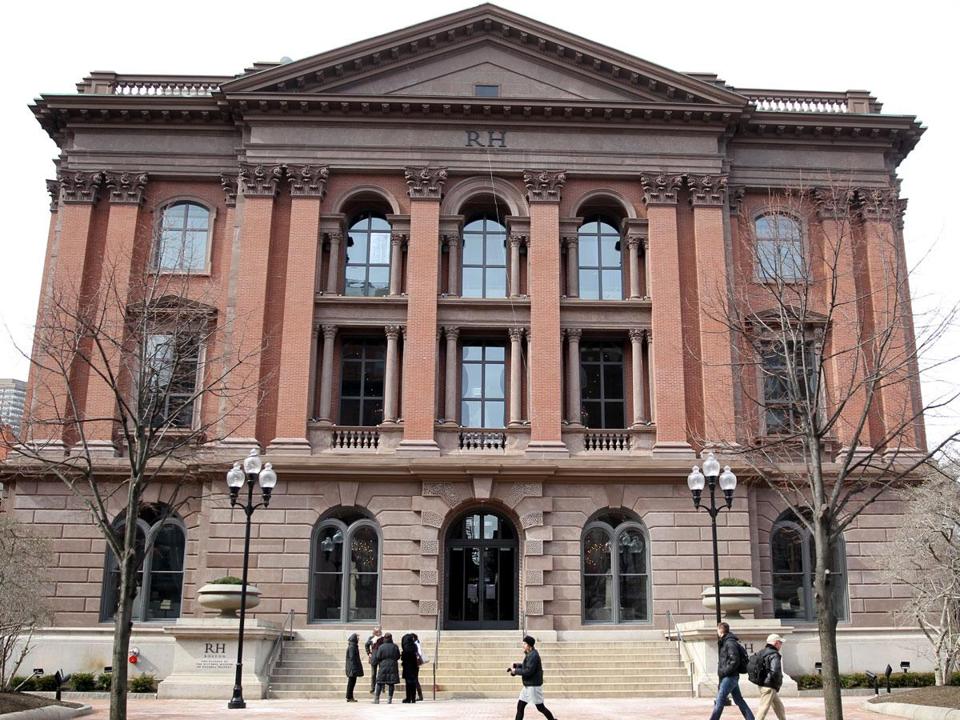
 It's Good to Live in a Two-Daily Town