Marty Baron’s Swan Song

December 10, 2012

Call it Marty Baron’s Last (Pulitzer) Waltz.

The Boston Globe editor is leaving to become editor of the Washington Post in January, but in the meantime he’s leaving this: A three-part series called Justice in the Shadows, which details – in impressive detail – the thousands of “convicted criminals released since 2008 because their native countries would not take them back.”

The first installment ran in the Boston Sunday Globe:

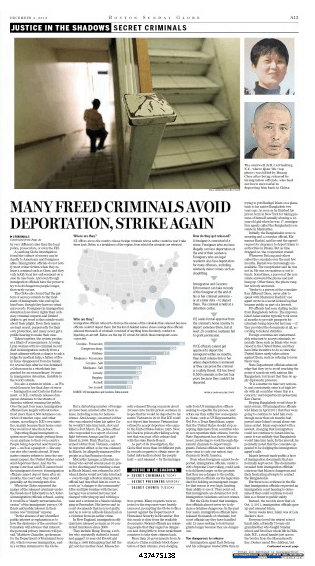
greene_secretcriminals2_metJUSTICE IN THE SHADOWS | SECRET CRIMINALS

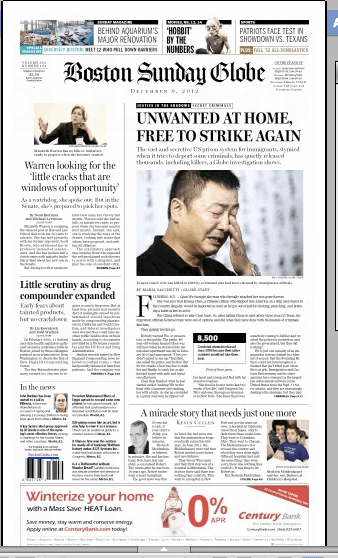
UNWANTED AT HOME, FREE TO STRIKE AGAIN

The vast and secretive US prison system for immigrants, stymied when it tries to deport some criminals, has quietly released thousands, including killers, a Globe investigation shows.

FLUSHING, N.Y. — Qian Wu thought the man who brutally attacked her was gone forever.

She was sure that Huang Chen, a Chinese citizen who slipped into America on a ship and stayed in the country illegally, would be deported as soon as he got out of jail for choking, punching, and pointing a knife at her in 2006.

But China refused to take Chen back. So, after jailing Chen on and off for three years in Texas, immigration officials believed they were out of options and did what they have done with thousands of criminals like him.

They quietly let him go . . .

Chen then finished what he had started earlier, bashing Wu on the head with a hammer and slashing her with a knife. As she lay crumpled in a grimy stairwell, he ripped out her heart and a lung and fled with his macabre trophies . . .

Wu is just one casualty of an immigration system cloaked in a blanket of secrecy that the Founding Fathers could not have imagined, a blanket that isn’t lifted even when life is at risk.

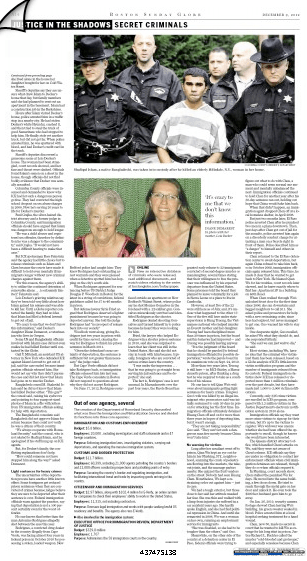
The Globe has dedicated some serious newshole space to this series. Sunday’s real estate review:
Picture 1


Picture 3


Picture 4

Picture 5

And still two parts to come.

Like we said – serious newshole space, serious Pulitzer push.


It’s Good to Live in a Two-Times Co. Town (Paywall Edition)

December 9, 2012

As newspaper revenues continue to go down like the Hindenburg, more and more dailies are looking to erect paywalls to corral new cashflow.

Exhibit Umpteen: The Washington Post.

From David Carr’s post on the New York Times Media Decoder blog (via Politico’s Playbook):

fence-decoder-blog480Pay Wall Push: Why Newspapers Are Hopping Over the Picket Fence

When The Wall Street Journal broke the news that The Washington Post was likely to start charging for online content sometime next year, it should not have come as a surprise, but it did.

The shock had something to do with the certainty that Donald Graham, chairman of the Washington Post Company, has always displayed on the subject. He has long had serious reservations about putting the work of his company’s journalists behind a wall. According to GigaOm, he explained it in the following way to Walter Isaacson at an Aspen Institute event:

The New York Times or Wall Street Journal can say we’re going to charge, but we’re not going to charge you if you subscribe to the newspaper. The Washington Post circulates in print only around Washington, D.C., but way over 90 percent – I think over 95 percent of our Internet audience is outside Washington, D.C. We can’t offer you that print or online choice. So, the pay model would work very differently for us.

But now The Post is contemplating a model in which the homepage and section fronts will be free, but the rest will require a subscription, which is a pretty nifty way to allow for snacking while hoping that people stick around to eat.


But some who’ve gone this route aren’t getting all that many bites. Among them is NYT kissin’ cousin the Boston Globe. Here’s what Carr writes about the two:

The New York Times’s positive experience with online subscriptions is probably not one that will scale across the industry. As a national newspaper with international resources, The Times is fishing in a pool of many millions of potential readers, so the fact over a half a million of that audience has opted in is a good sign for the organization, but not necessarily for the industry.

Mr. Graham noted that The Boston Globe, the former home of the incoming Post editor Martin Baron and a high-quality publication, had just 25,000 people sign up. That is a scary low number. But it is a place to begin.


Yeah, so’s zero. That don’t make it good news.


Herald: Baron Jumps Sinking Ship?

November 14, 2012

Today’s Boston Globe has the front-page story on the exodus of editor Marty Baron.

11-year Globe editor Martin Baron to depart

Will take reins at Washington Post

Martin Baron , the editor of The Boston Globe who led the news organization as it won six Pulitzer Prizes over the past decade, will become executive editor of The Washington Post in January, both papers said Tuesday.

The Globe will launch a search to fill Baron’s job, said publisher Christopher M. Mayer. While citing the talent within the newsroom, he said he would also consider outside candidates. Mayer said his aim is to fill the position as quickly as possible.

“We’re looking for the right person at the right time to really carry on the quality journalism that’s the embodiment of everything we are doing today,” Mayer said in an interview.

In his valediction to the Globe newsroom, Baron asserted that his departure has nothing to do with the fiscal fitness of the paper.

Noting that he navigated through difficult times for the news business, Baron said New England’s largest newspaper has emerged as a sound institution. “We’re on solid footing here at the Globe,” he said. “The Globe has a good future ahead of it. “

Not if you listen to the Boston Herald, which says it has the inside story.

Globe editor departing for gig at Washington Post

Baron successor all the talk

The long-rumored departure of Boston Globe editor Marty Baron for the top slot at The Washington Post — the beleaguered broadsheet’s third bigwig to jump ship in recent months — has roiled the Morrissey Boulevard newsroom and set tongues wagging about a possible fire sale.

“He may think that the clock is ticking, it’s time to get out,” said Benchmark Co. analyst Edward Atorino. “The Post is going to be around forever, whereas the Globe — not sure.”

Of course, that’s exactly what you’d expect a Herald piece to say. But at least columnist Jessica Heslam spiced it up with some speculation:

Scuttlebutt has it that Times metro editor Carolyn Ryan, a former Herald and Globe staffer, could come in as a caretaker editor in a move that could signal a sale of the paper.

Among the inside candidates bandied about: Globe editorial page editor Peter Canellos, deputy managing Sunday editor Mark Morrow, associate editor and metro columnist Brian McGrory and managing editor Caleb Solomon.

(The Globe’s kissin’ cousin down in New York just teased readers: “Three internal candidates [at the Globe? the Times?] have been named as possible successors. A spokesman for the Times Company said a national search would be conducted.”)

No dish from the Globe yet. At least not in the paper.


John Kerryoke’s Musical Chairs

November 13, 2012

It’s Post time at the local dailies in the race to cover the Obama administration’s national security team fire drill.

Both papers pick up a Washington Post story this morning. The Globe’s version, predictably, is lengthier.

Kerry may be choice for secretary of defense

Security shuffle follows Petraeus’s departure

WASHINGTON — President Obama is considering asking Senator John F. Kerry, Democrat of Massachusetts, to serve as his next defense secretary, part of an extensive rearrangement of his national security team that will include a permanent replacement for former CIA director David Petraeus.

Although Kerry is thought to covet the job of secretary of state, senior administration officials familiar with transition planning said that nomination will almost certainly go to Susan Rice, the US ambassador to the United Nations.

John Brennan, Obama’s chief counterterrorism adviser, is a leading contender for the CIA job if he wants it, officials said. If Brennan goes ahead with his plan to leave government, Michael Morell, the agency’s acting director, is the prohibitive favorite to take over permanently. Officials cautioned that the White House discussions are in the early phases and that no decisions have been made.

The Herald pickup is much shorter (and massaged by reporter Joe Dwinell), but it includes something the Globe doesn’t: The Great Mentioner.

If Kerry goes to Defense, the scramble for his seat would quickly move U.S. Sen. Scott Brown back into the picture, or possibly former Gov. William F. Weld, a fellow Republican. On the Democratic side, U.S. Rep Edward J. Markey has been mentioned as a possible candidate. State Attorney General Martha Coakley could also take another shot at higher office.

Let the wild Special Election Rumpus begin!