Globe Op-Ed Page Plays Hardball with Boston Herald

February 1, 2013

From our Late to the Party desk

Wednesday’s Boston Globe op-ed page featured a piece by sports economist Andrew Zimbalist spanking former Red Sox manager Terry Francona for criticizing the Sox owners in his new book as being more interested in money than the game of baseball.

Zimbalist calls Francona’s narrative “as unconvincing, as it is, at points, nasty, petty, inaccurate, and unfair.” That’s not the only thing that’s unfair in this piece. Here’s how it starts:

10232011_1023oped_vennochi-8075467Francona’s petty payback to Sox owners

IN “FRANCONA, the Red Sox Years,” Terry Francona, with the aid of Globe columnist Dan Shaughnessy, has given us his version of his eight years in Boston. They were very successful years for the team — two World Series victories, six trips to the playoffs. Presumably, Francona should get at least some of the credit for this success, though it is not clear how much.

The problem for Francona is that it all ended with the September swoon in 2011 and many seem to blame him. Francona, after all, reportedly had a wild year — a marital separation, a painkiller problem, and then the incident reported by Bob Hohler in the Globe of Jon Lester, John Lackey, and Josh Beckett drinking beer, eating fried chicken, and playing video games in the clubhouse during games. The inevitable, and seemingly reasonable, inference was that Francona had lost control of the team.
 

Wait a second. As best the hardreading staff recalls, the Boston Herald’s John Tomase broke the beer-and-chicken story.

C’mon, Globies. Credit where credit’s due.


Dan Shaughnessy (Steno Edition)

January 21, 2013

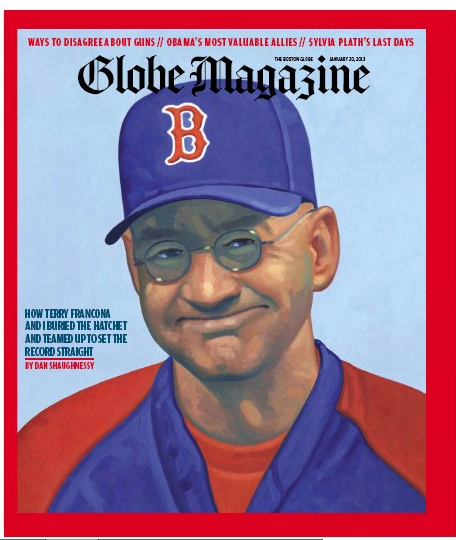
The cover story in the Sunday Boston Globe Magazine features sports columnist Dan Shaughnessy’s promo for his new book  on former Red Sox manager Terry Francona.

Picture 1


Set the record straight?

Maybe not so much.

From Shaughnessy’s piece:

Our writing process was simple and structured. Terry and I would meet, usually in a hotel coffee shop or restaurant. I’d record a couple of hours of conversation, then disappear for a few weeks to write. When a chapter was finished, I’d e-mail it to Terry, and he’d call back with corrections, clarifications, and occasionally a deletion.

“Do we have to call Heathcliff Slocumb ‘useless’?” he’d say. “Let’s take that out.”

Gone.

“I know you don’t like Schill, but we’re not going to call him a blowhard in my book.”

Fine. Schill is not a blowhard. Not in this book, anyway.


And Shaughnessy was not a journalist. Not in this book, anyway.

Michael Silverman’s Baseball Notes column in the Sunday Boston Herald reinforced that point.

Terry FranconaTito:  Book no hatchet job

Terry Francona did not set out to hurt anybody’s feelings when he co-wrote a book about his eight years with the Red Sox.

If the owners are not happy with their portrayal — and how could they be? — as being more concerned with image than substance and as not loving baseball as much as Francona, the former Sox manager owns up to that.

He felt he was being honest, after all. When he was fired or quit in October 2011, his own feelings were hurt. So, without any malice or forethought on his part, it sounds kind of natural to Francona that not everyone is going to be chuckling about how they are portrayed in the book.


Actually, no one but the owners will have anything to complain about. That’s because, according to Silverman, “[a]ny potentially touchy stories about players were vetted, via one-on-ones with Shaughnessy, so that nobody is surprised.” And Francona adds, “I checked with everybody — I didn’t use anything that I thought would make people mad.”

Anyone besides the hardreading staff mad about that?


Hall of Shame Bakeoff: Joe Fitz vs. Dan Shaughnessy

January 12, 2013

No Hall of Fame inductees for you!

And – wait for it – very different takes in the local dailies.

Dan Shaughnessy’s Thursday Boston Globe  column:

46171382H6239713A Hall of Fame ballot without a whiff of PED usage

The poison ballot remained on my desk, unopened until Dec. 31.

I knew what was in there. Hardball anthrax. Nothing could be gained from tearing it open. Only bad things could come of it.

But I am a card-carrying member of the much-loathed Baseball Writers Association of America. I’ve been honored with a Hall of Fame ballot since 1987. It’s the most important responsibility that comes with membership.

And it has become the worst exercise of the year.

On Wednesday, one day before the Oscar nominations are announced, the BBWAA will announce the results of this year’s Hall of Fame election. It’s going to be another dreadful day for the BBWAA, for baseball, for Mom, apple pie, and America.

I voted for Jack Morris, Tim Raines, Alan Trammell, and Curt Schilling.

I did not vote for the greatest home run hitter of all-time. I did not vote for a guy who won 354 games and seven Cy Young trophies. I did not vote for a guy who hit 60 or more homers in a season three times. I did not vote for a catcher who hit 427 home runs. I did not vote for a first baseman who hit 449 home runs. I did not vote for a guy who hit 569 homers and cracked 3,020 hits. I did not vote for a guy who hit 70 homers in a season.


Joe Fitzgerald’s Boston Herald  column today:

Hall of Fame BaseballWhy I cast Hall of Fame vote for Clemens

When a few folks discovered this writer had a vote in last month’s Hall of Fame balloting, there was not only an interest in the decisions he made, but also a demand to know what he was thinking if he wasn’t on the same page they were, as if a disagreement was intensely personal to them . . .

For what it’s worth, here’s why Roger Clemens received a vote here, a vote that had much less to do with baseball than it did with adherence to a principle.

First of all, if Clemens used a performance enhancer, it was not to have a Hall of Fame career, but rather to extend one.

The key word there is “if,” though very little doubt exists in the court of public opinion. Thankfully, the court of public opinion isn’t where we look for justice.

The law tried to nail Clemens twice and it failed both times.

But that made no difference to many of the writers who would ban him, explaining suspicions were sufficient to deny him induction.

Suspicions? Is that all that’s now needed to convict someone?

Sorry, boys, it doesn’t work that way, or at least it’s not supposed to.

Different strokes for different papers.

Good, yes?