Tom Menino’s Snow Job

February 13, 2013

The Boston Herald nails Mistah Mayah on Page One today.

Picture 1


Columnist Joe Battenfeld’s piece has the damning details. (As with snowflakes, no two campaign contributions are alike.)

NEL_8557.JPGMayor $hoveling it in

Review: Plow contractors are big donors

Mayor Thomas M. Menino may have scolded the city’s snow plow contractors for their slow performance in last weekend’s blizzard, but they have done a stellar job at plowing something else — tens of thousands of dollars into Menino’s campaign war chest, the Herald has found.

Menino has raked in more than $60,000 from executives, family members and employees of private companies that have won contracts to clear the city’s streets, according to a Herald review.
 

But wait – there’s more:

The mayor also has questioned the handling of the blizzard by his Public Works Department, but he shouldn’t be too surprised. His hand-picked commissioner, Joanne Massaro, had no experience in public works or dealing with storms when Menino hired her three years ago. Massaro’s last job was as interim head of the Department of Neighborhood Development.


Ouch. Crosstown at the Boston Globe, the coverage is more City Hall Gazette than the feisty local tabloid’s.

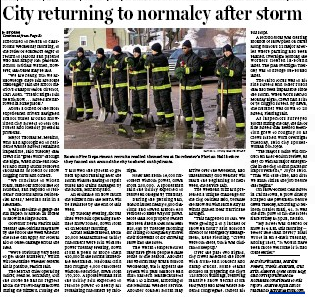
Picture 6Boston parking ban lifted, schools set to reopen

Boston finally lurched toward normalcy Tuesday after a debilitating blizzard, ending a 102-hour-long parking ban on major streets and announcing that public schools would reopen for the first time since the storm struck.

Near springlike temperatures began melting snow mountains into lakes of slush. Waterlogged and unshoveled sidewalks forced scores of pedestrians into plowed streets, where they walked on black asphalt with briefcases and grocery sacks, slowing traffic.

The end of the parking ban brought a glint of hope for frustrated drivers, who suddenly had thousands of open spaces. The city’s 57,000 public school students were scheduled to return to classrooms Wednesday morning, to the relief of educators eager to return to lessons and parents who had simply lost patience. School officials warned, how ever, that buses may be late.

“We are ready, but we acknowledge there still are some challenges,” said the school district’s transportation director, Carl Allen. “Traffic might still be a bit slow. . . . Streets are narrowed in some places.”

 

Yeah? Really?

The hardreading staff especially likes the headline above the jump on page 3:
Picture 5


Tom Menino in bed with the business community. That’s what qualifies as normalcy in Mayberry East.


Boston Dailies Are Papal Tigers

February 12, 2013

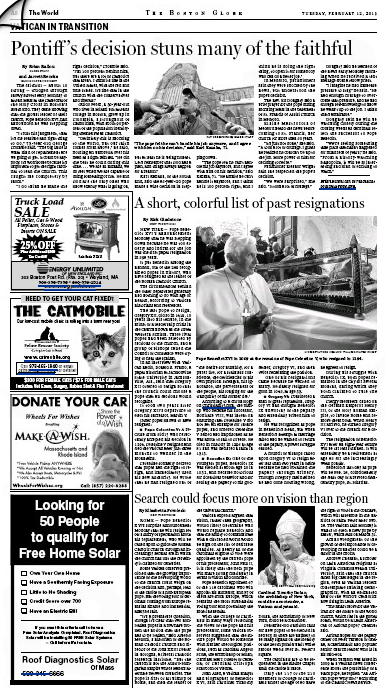
In this most Cathaholic of towns, the Boston Globe and the Boston Herald are on Pope Benedict XVI’s resignation like Brown on Williamson.

For starters, the old Pontifox owns both front pages.

Picture 2
Picture 1


From there he gets Vatican-size chunks of the newshole – three full pages in each.

Picture 3

Picture 4

Picture 5

Picture 6


Not to mention his own editorial in each paper.

Herald:

The pope who resigned

In the end it wasn’t the Twitter account that made Pope Benedict XVI a truly 21st century pope. No, it was his decision to resign — a nearly unprecedented action — when he knew that age had robbed him of the ability to minister to his flock of 1.2 billion Catholics around the world.

“Strength of mind and body are necessary, strength which in the last few months has deteriorated in me to the extent that I have had to recognize my incapacity to adequately fulfill the ministry entrusted to me,” the 85-year-old pontiff wrote in the message announcing his decision.


Globe:

Benedict’s strict teachings defined an era in Catholicism

THROUGHOUT HIS nearly eight-year papacy, and for 25 years before that as the Vatican’s chief doctrinal officer, Pope Benedict XVI steered the Catholic Church away from the liberalizing reforms symbolized by the Vatican II conference of 1962. His strict interpretation of Catholic teachings led to a proportionally greater emphasis on the church’s opposition to birth control, abortion, and homosexuality. Meanwhile, the Vatican asserted tighter authority over church affairs, a reversal of the decentralizing trends of an earlier era.

These shifts in focus sometimes put the Vatican at odds with followers in the West; Benedict, in turn, expressed concern over the loss of faith among many Catholics in Western Europe and the United States . . .


But the Herald gets the Popeier-than-thou nod for also featuring an op-ed by Boston College professor of moral theology James T. Bretzke, and this Jerry Holbert cartoon:

holberts 02-12 cartoon


Bingo.


Throwing the Book(s) at Whitey Bulger

February 11, 2013

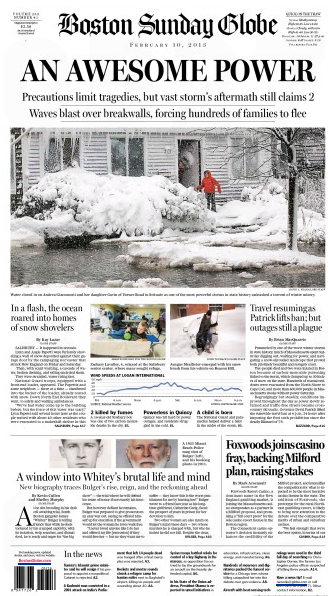
Dueling book plugs in the local dailies the past two days, starting with this Boston Sunday Globe Page One pompom:

Picture 3A window into Whitey’s brutal life and mind

New biography traces Bulger’s rise, reign, and the reckoning ahead

As he sits brooding in his drab cell awaiting trial, South Boston gangster James “Whitey” Bulger is telling friends that while he feels tortured by his cramped captivity, with its isolation, strip searches, and dismal food, he is ready and eager for “the big show” — the trial where he will defend his sense of honor if not exactly his innocence.

But however defiant he remains, Bulger was prepared to give prosecutors an easy way out, saying he offered himself up for execution if the government would let the woman he loves walk free.

“I never loved anyone like I do her and offered my life [execution] if they would free her — but no they want me to suffer — they know this is the worst punishment for me by hurting her!” Bulger wrote to a friend last year as his longtime girlfriend, Catherine Greig, faced the prospect of years in prison for her devotion to him . . .

“Whitey Bulger: America’s Most Wanted Gangster and the Manhunt That Brought Him to Justice,” written by the authors of this article (Kevin Cullen and Shelley Murphy), with editorial support from The Globe, reveals a host of new information about Bulger, from his pursuit of domestic tranquillity in a tangled romantic triangle, to his seeking out a psychiatrist a la Tony Soprano, to his heretofore little-known role as an agent of mayhem during the city’s school desegregation crisis.


Lots of juicy stuff in the “new and comprehensive biography” that just hit bookstores.  Meanwhile, columnist Howie Carr blurbs a different Bulger book in today’s Boston Herald .

021013whitey001Book: Whitey’s rage at black prez led to his capture

Can Whitey Bulger blame his own raging case of Obama Derangement Syndrome rather than a tabby cat for his 2011 capture?

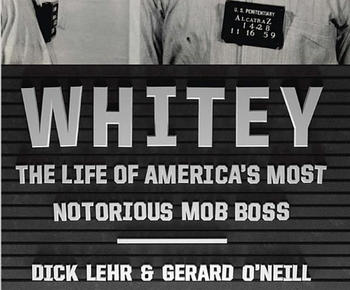
That’s the suggestion in a bombshell new biography, “Whitey: The Life of America’s Most Notorious Mob Boss,” by veteran Boston reporters Dick Lehr and Gerard O’Neill.

When Whitey and moll Catherine Greig had been living in Santa Monica, Calif., as “Mr. and Mrs. Charlie Gasko,” Greig became close to Icelandic model Anna Bjornsdottir, bonding over the care of a stray cat. Whitey often joined them outside their apartment building.

But, Lehr and O’Neill write, Bjornsdottir and Whitey never spoke again after she “unabashedly” expressed admiration for the first black president.

“He practically exploded … disgusted that she could admire a black man as president … Nothing was the same after . . . “


Carr conveniently fails to mention 1) that Lehr and O’Neill are former Boston Globe reporters, and 2) that Cullen and Murphy have a new Whitey bio as well.

The Globe piece is more magnanimous:

[Bulger’s] first known cooperation with law enforcement was in 1956, when he agreed to identify his bank robbery accomplices so that his then-girlfriend would not face criminal charges for accompanying him on a trip that culminated with a bank robbery in Indiana. That early turn as a snitch was first reported by WBUR, citing documents obtained by two former Globe reporters, Gerard O’Neill and Dick Lehr, who also have a biography of Bulger coming out soon: “Whitey: The Life of America’s Most Notorious Crime Boss.”


And getting even more so by the day.


Gov. Patrick’s Driving Ban Didn’t Keep This Carr Off the Road

February 11, 2013

First, a personal note:

V-I-C-T-O-R-Y, victory victory that’s our cry!

The hardlyreading staff went out earlier today to find some actual newspapers – and we actually did. As we carried them triumphantly back to the Two-Daily Town Global Worldwide Headquarters, we discovered inside the front door – newspapers!

The Sunday papers. And Saturday’s papers. Big shoutout to our delivery guy.

Result: An embarrassment of dailies.

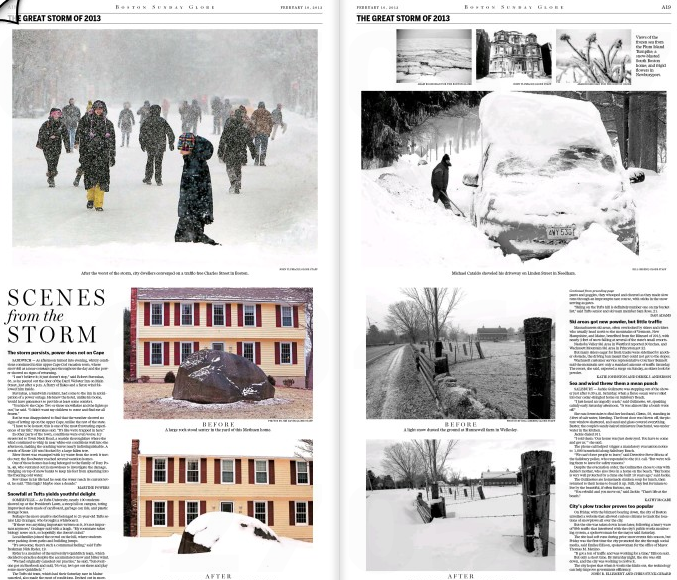
As we plowed through the weekend’s storm coverage, one topic stood out: Gov. Deval Patrick’s “extraordinary step,” as Saturday’s Boston Globe dubbed it, that banned driving during the storm.

From the stately local broadsheet:

Travel ban surprises many, pleases some

Governor Deval Patrick’s strict travel ban Friday stunned pizza deliverers and police chiefs alike, shuttering shops, befuddling taxi drivers, and leaving police officers wondering if they had to ticket drivers dashing to the store for a gallon of milk.

Some criticized the governor for his last-minute edict and the stiff penalties it carried — up to a year in jail and a $500 fine to any nonemergency personnel on the road after 4 p.m. — while others doubted that storm-swamped police would have time to enforce the ban.

But those who recalled the nightmare highway strandings in the Blizzard of ’78 praised Patrick’s order — including the former governor who wished he’d taken similar action sooner 35 years ago.

“There’s no question that the governor’s doing exactly the right thing — have people home, get them off the streets, and just cool it,” said former Massachusetts governor Michael Dukakis, speaking from Southern California, where he now teaches at UCLA. [Where it rarely snows, not to get technical about it.]


Others, however, called the ban “tyrannical.” Crosstown at the Boston Herald, it was “absolutely draconian,” according to one local cabbie. But Herald columnist Joe Battenfeld disagreed:

Finding NemoPatrick does it right

Learning from Dukakis’ error, gov still takes heat

You can’t blame Gov. Deval Patrick for not wanting to pull a Michael Dukakis.

In the blizzard of 1978, the state was woefully unprepared for the massive storm. Gov. Dukakis did issue a travel ban but it came too late — after dozens died and thousands were stranded on the roads.

So now Patrick tries to prevent deaths by banning cars on the road and he gets trashed by critics who say it’s an example of government gone too far.

Can you imagine the outrage if Patrick had done nothing and the blizzard ends up claiming lives?


That, of course, is nothing compared to the outrage of fellow columnist Howie Carr for the inconvenience Patrick cost him.

801O7669.JPGDriving ban? Take a hike, gov

Hey Gov. Patrick, didn’t your mother ever teach you about the magic word “please”?

You know, you’d ask her for something, and she’d say, “What’s the magic word, Deval?”

I guess she didn’t because I didn’t hear it Friday, when you ordered everyone in the state off the roads at 4 p.m. Like everyone else, I did hear about the $500 fine and/or one year in jail for violating your order, which you had said the previous day you probably weren’t going to issue.


Carr proceeds to take a predictable swipe at “the bow-tied bumkissers . . .  already falling all over themselves lauding you for your ‘wise’ decision to shut down business statewide and arrest anybody who had the audacity to try to get home from work.” (So Joe Battenfeld is a “bow-tied bumkisser,” Howie?)

But then Carr gets at the real pathos of the travel ban:

Myself, I’d hired a guy to drive me home Friday night. I was going to leave my car warm and safe in a garage in Brighton. But then he heard about the year in jail, and he chickened out.

So I called Veterans Taxi. At 5 p.m., Veterans called back and said the cops had just ordered them off the road. In other towns, the police were doing robo-calls, a chance to throw their weight around, too.

I wasn’t that worried driving home. I had press credentials, and if any cops had stopped me, I figured I would just tell them I was Police Commissioner Edward F. Davis’ son.


There’s your man of the people, Herald readers, whining that “now my car is in the driveway, totally buried in snow.”

Boo hoo, Howie. Welcome to the real world.


It Blows to Live in a No-Daily Town (Nemo Edition)

February 10, 2013

Once again, no newspapers for the hardreading staff. So, it’s back to the ePapers.

Front pages first. (We’re starting to feel like Fiorello Laguardia during New York’s 1945 newspaper strike.)


Boston Herald:

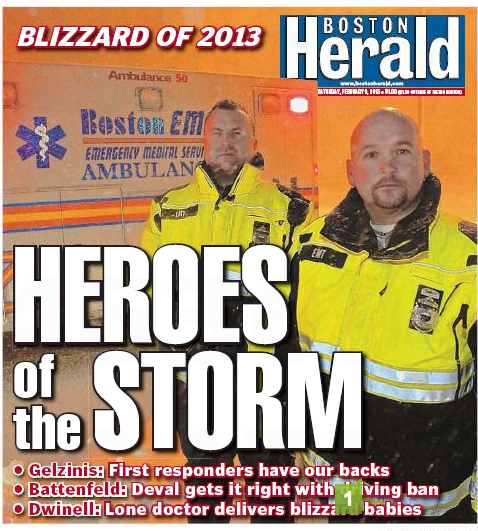
Picture 1


Boston Globe:

Picture 9


Human interest next.

Herald:

Picture 12


Globe:

Picture 13


Finally, sports pages.

Herald:

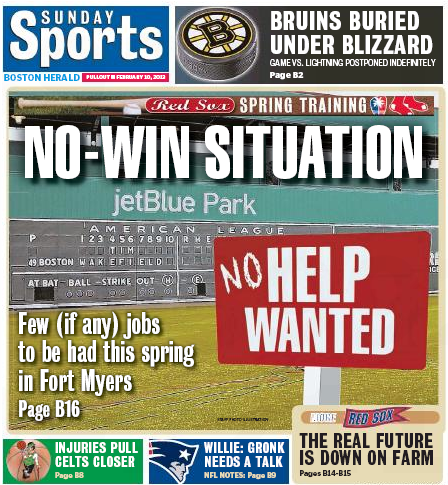
Picture 2


Globe:

Picture 6


The hardpasting staff will now trundle around Brookline Village in search of actual papers. Details at . . . whenever.


It’s Good to Live in a Two-ePaper Town (Nemo Edition)

February 10, 2013

Well the hardreading staff just trundled around Brookline Village in search of newspapers to no avail, so we decide to hie ourselves over to the local ePapers for a quick compare-and-contrast.

First, the front pages.

Boston Herald:

Picture 5


Boston Globe:

Picture 8


Then, news spreads.

Boston Herald:

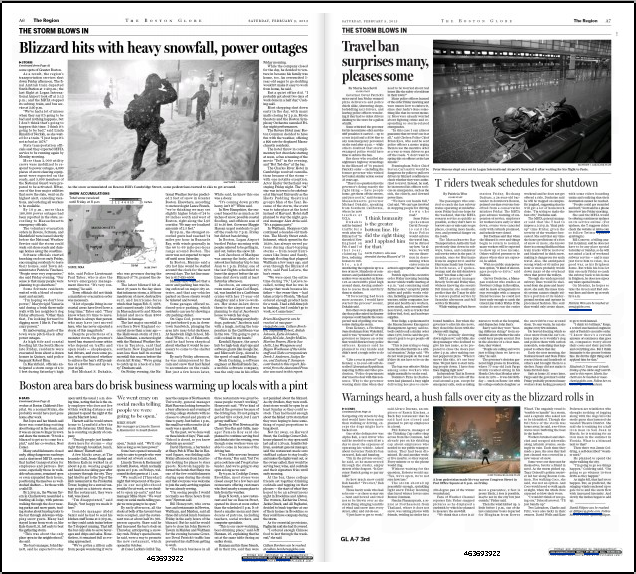
Picture 6


Boston Globe:

Picture 7


Finally, photo galleries.

Boston Herald:

Picture 4


Boston Globe:

Picture 2

Nice work all around, eh?


Two-Daily Town Goes Digital!

February 9, 2013

No papers for you today!! (One screamer for each daily.)

So the hardreading staff will be poking around the digital editions of the local dailies today. For starters: home pages.

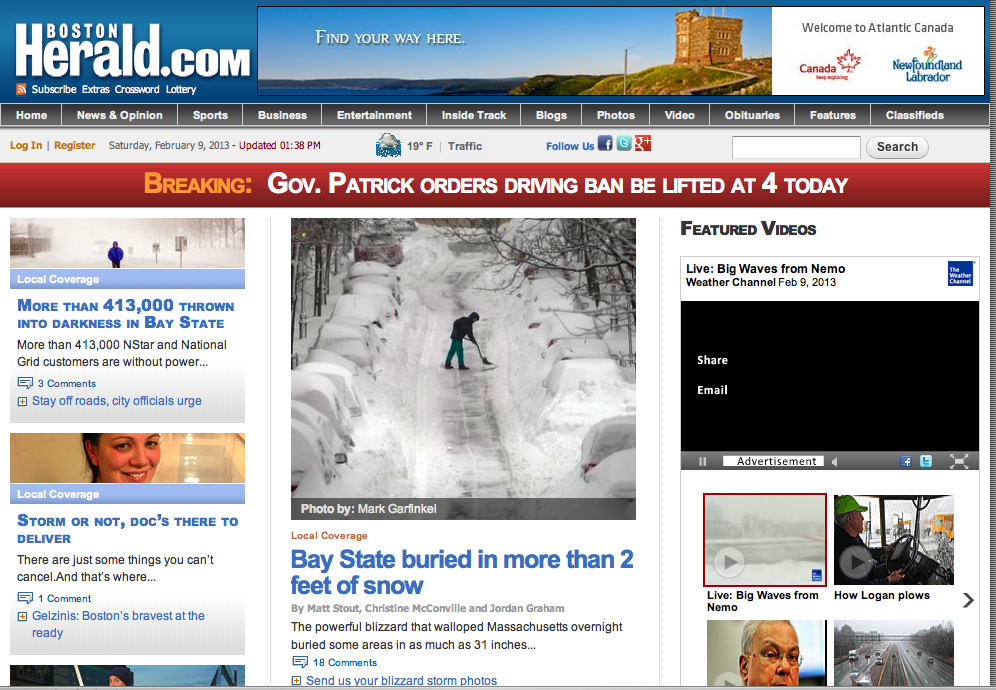
Boston Herald:

Picture 2


Boston Globe:

Picture 4


Back atchya with E-Papers soon.


Herald Beats Globe in Boston Storm History Bakeoff

February 9, 2013

The Boston Herald might have missed out on the Newseum’s Top Ten Front Pages today, but the feisty local tabloid is far superior in the Boston Big Storms graphics showdown with the Globe..

The  stately local broadsheet featured a standard-issue bar chart on Page One:

Picture 4


Closer look:

Picture 3


The feisty local tabloid, on the other hand, gave us a guided tour through history:

Picture 5


Closer look:

Picture 7


Nicely done, Heraldniks. Nicely done.


Globe Beats Herald in Storm Front (Page) Bakeoff

February 8, 2013

The Boston Herald has long been a self-promotion machine, touting some coverage that led to government action or crowing about its inclusion in the Newseum’s Top Ten Front Pages on a particular day.

But not today, because that latter distinction belongs to crosstown rival Boston Globe.

How’s the Weather?

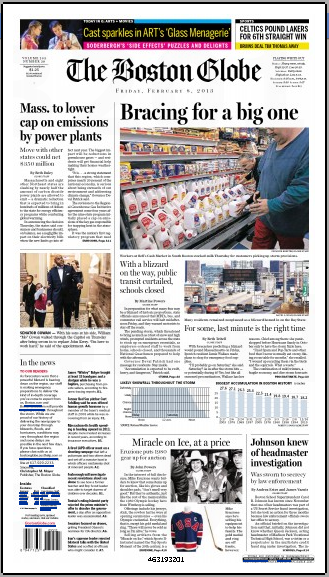
As the Northeast braces for a potential blizzard for the ages, front pages in that region are doing the same and preparing readers for the impact. AM New York offers a “Blizzard Survival Guide.” “Bracing for a big one,” The Boston Globe warns. Are newspapers still relevant? In times like these, they’re just as essential as milk, batteries, water and toilet paper.


The stately local broadsheet’s Page One:

Picture 1


The feisty local tabloid’s also-ran:

Picture 2


Hey – win some, lose some. But the beauty of the daily bakeoff is, there’s always tomorrow.

Plow on, Heraldniks.


Where’s the Boston Herald’s Review of ‘Jersey Boys’?

February 8, 2013

Jersey Boys – the long-running Broadway hit musical – has come to Boston’s Colonial Theater with mixed results at the local dailies.

Terry Byrne reviewed the production a week ago in the Boston Globe:

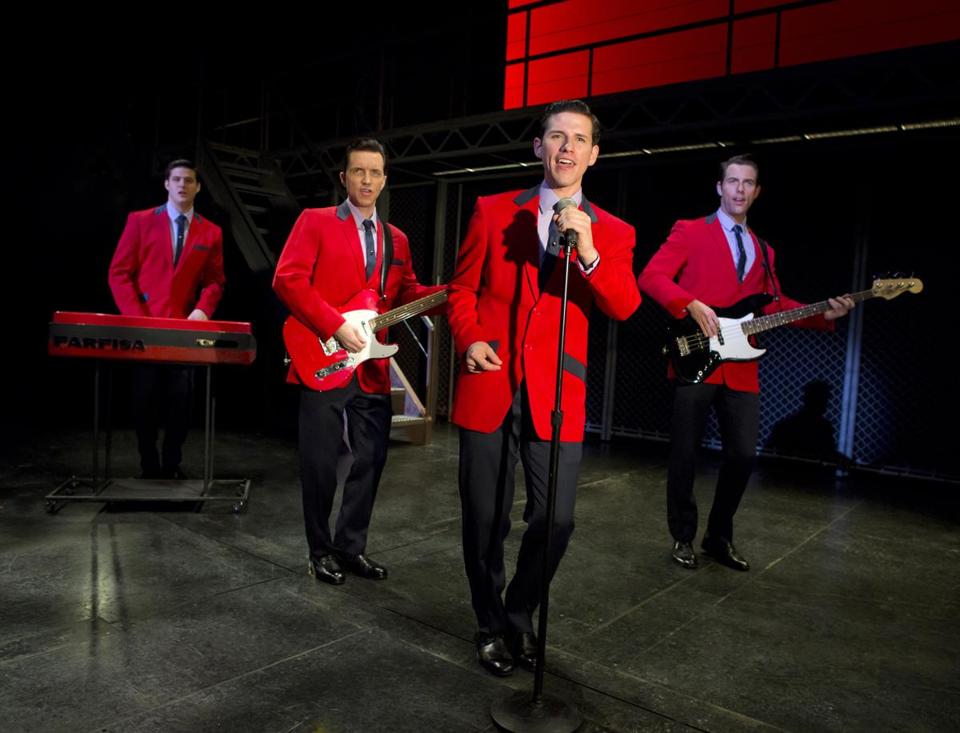
In ‘Jersey Boys,’ the songs tell the story

d Sherry Oct 12 - photo by Jeremy Daniel

Four voices, four stories, one thrilling sound. There’s no denying “Jersey Boys,” the story of Frankie Valli and the Four Seasons, now playing at the Colonial Theatre, follows the overused jukebox musical formula, but what makes this show rise above the others is that sound, and the four men who made it.

It’s easy to forget the number of hits the Four Seasons had, and how irresistibly toe-tapping those songs are. From “Sherry” and “C’mon, Maryann,” to “Rag Doll” and “You’re Just Too Good to Be True,” the writing team of Bob Gaudio and and Bob Crewe found delicious pop hooks that propelled the Four Seasons to the top of the charts throughout the 1960s. At the performance I saw, many in the audience not only tapped their toes, they sang along to every song. And what other musical can you name that has the crowd cheering at the arrival of a six-piece horn section?

“Jersey Boys” boasts a book written by Marshall Brickman (best known for his screenplays with Woody Allen) and Rick Elice (“Peter and the Starcatchers”), who lay out the rags-to-riches tale of four boys from just outside Newark in simple chronological order, but along the way, they carefully draw characters whose motives are clear and whose relationships are complicated.


In the end, though, “Jersey Boys” comes up short, Byrne says:

In this touring production, some of director Des McAnuff’s unimaginative staging shows through because there is unevenness among the performances, and Sergio Trujillo’s choreography looks forced rather than precise.

As a Jersey Girl myself, I might be overcritical, but Jacoby, whose bio says he’s originally from Boston, struggled to find an accent that sounded consistently like anything, let alone Jersey, and he also had some trouble staying on key while singing. Cosgrove, while he hit those high notes without hesitation, never locked in to the character of the honest guy who stayed loyal to his friends no matter what.

But “Jersey Boys” is about the Four Seasons’ music, and as the audience reaction showed, these songs stand the test of time.


The Herald, on the other hand, says . . . nothing.

What – is the feisty local tabloid waiting for the production to get better?

It’s not gonna, as they say in Jersey.