Well, for starters, give them an exclusive on his daughter’s big day – and dress. In return, Scott Brown (R-Elsewhere) got this:
And this:
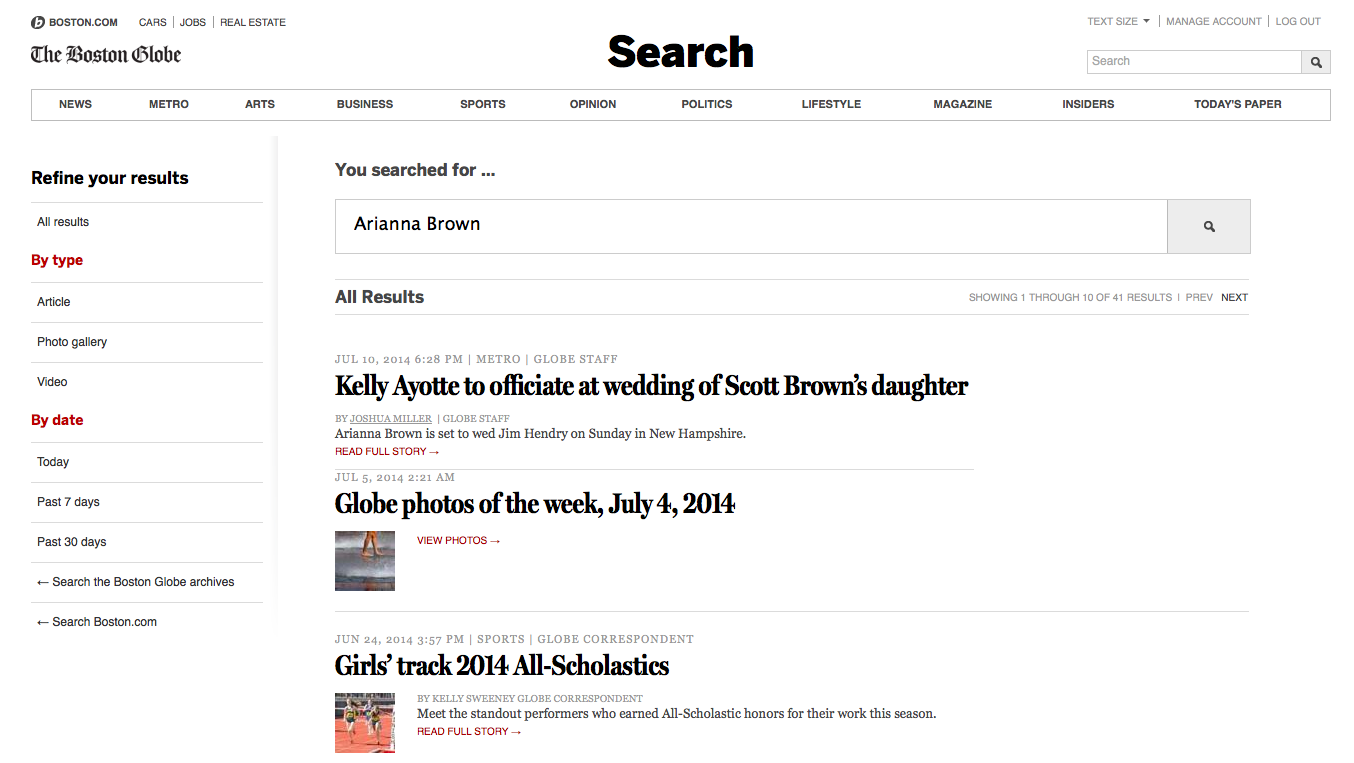
Not only is it a touching story (“The first time Huff saw her daughter in her wedding dress, she wept, she said.”), it’s also exclusive to the flouncy local tabloid. The Boston Globe got bubkes, as a search of the stately local broadsheet indicates.
As you can see, the Globe hasn’t been on Arianna Patrol since that July 10 piece headlined “Kelly Ayotte to officiate at wedding of Scott Brown’s daughter.”
And so she did. You just wouldn’t know it from the Globe.
For two days now the Boston Herald has featured a series called No Fare, which examines the Boston cab industry and holds a bakeoff between the Uber mobile-app car service and traditional taxis. (Sounds like the little brother of last year’s Boston Globe taxidermy of the industry? Let’s not get technical with the filchy local tabloid, eh?)
But the hardreading staff would take issue with today’s front page.
Yeah, that WE GO UNDERCOVER is a bit of an overstatement: The taxis vs. Uber ratings involved Herald reporter Erin Smith’s taking “more than a dozen test trips . . . between Logan International Airport and Kenmore Square, as well as other destinations, over the past week.”
And here’s the result:
Don’t get us wrong – that’s good work, and Smith is hardly responsible for the hyperventilating headlines the Herald editors hatch.
But undercover? C’mon. The Globe had a reporter actually drive a cab in its expose, and better yet, he got into an accident like a real cabdriver.
The Boston Globe’s taxidermy of the local cab industry last year has left some tire tracks on the stately local broadsheet. From the start, as the hardreading staff dutifully chronicled, crosstown rival Boston Herald has been on the Globe’s Driven to the Edge series like Brown on Williamson, especially since Globe reporter Bob Hohler got into an accident while posing as a cab driver. (Globe editor Brian McGrory insisted at the time that “[Hohler] was not masquerading as a cab driver, he was a cab driver.” And a reporter. Potato-potahto. Yesterday, the frisky local tabloid reported that the whole thing has gone to lawyers.
Pair sue reporter in cab crash
A Boston Globe reporter who went undercover as a cab driver for a series of reports on the city’s taxi industry is being sued by two of his passengers, who are claiming more than $12,000 in medical expenses after a late-night crash in November 2012. Passengers Daniel Kim and Jiwoon Choi of Boston both endured “serious personal injuries, great pain and suffering, mental anguish, lost wages and/or diminished earning capacity” after their cab, driven by Globe reporter Bob Hohler, was struck by another car at the intersection of Stuart and Clarendon streets. The suit claims Hohler failed to “exercise due care” in driving the cab. Choi claimed she suffered a fractured left orbital bone, as well as neck, head and back injuries, racking up medical bills of $9,248. Kim injured his right knee, head and left hand with medical bills of $3,600, according to the suit filed in Boston Municipal Court.
The harddoubting staff doesn’t expect the Globe will report the suit in today’s edition, but we’ll keep you posted.
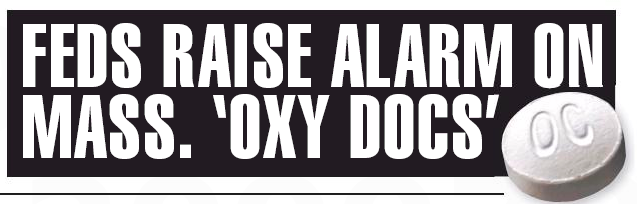
Bay State physicians rank in the top 10 nationally in prescribing OxyContin and other opiates, according to a shocking new federal report that experts say should be a wake-up call for local docs writing scripts for highly addictive drugs hand over fist.
“Those type of prescribers need to get the message: This is a deadly drug. These are highly addictive and there’s an over-prescribing of them,” said John McGahan, president of the South Boston-based Gavin Foundation, which provides education, prevention and addiction treatment.
“We’re not having people coming in saying, ‘I’m a heroin addict and I didn’t use prescription opiates first.’ It would be a rare bird,” McGahan said.
The piece goes on to note that “Massachusetts ranks eighth nationally and third in New England — behind Maine and New Hampshire — in the prescribing of so-called ‘extended-release’ painkillers.” It also points to a recent Herald report that “[showed] oxycodone prescriptions have spiked by roughly 27 percent over the last three years in Massachusetts . . . Oxycodone prescriptions for children have also increased by 34 percent across more than 25 pediatric specialties during the same three-year span.”
Yikes, eh?
But crosstown at the Boston Globe, the front-page story is slightly less, well, yikes.
State ranks low in prescribing of opioids
Long-acting pills an exception
Massachusetts physicians rank among the top 10 nationally in prescribing OxyContin and other long-acting painkillers, according to a government report released Tuesday that highlighted wide state-by-state variation in the rates of use of addictive opioid medications.
But the state ranked low, 41st nationally, for overall prescribing of opioids, which have become a major concern because of rising rates of abuse and overdose deaths. Long-acting pain medications such as OxyContin are only one of several types of opioids, which also include methadone, codeine, and hydrocodone.
Addiction specialists said the Massachusetts figures were encouraging.
We guess they just didn’t say it to the Boston Herald.
So, to recap for the umpteenth- hell, just see here.
The question is this: How did Marty’s Mash Note to the Boston Public Schools wind up as a full-page ad in last Wednesday’s Boston Globe?
On Friday, CommonWealth Magazine (which came late – but smart – to the party) reported the issue thusly:
THE BOSTON GLOBE FOUNDATION donated a full-page ad in Wednesday’s newspaper to Boston Mayor Marty Walsh so he could thank the staff of the Boston Public Schools at the close of the school year.
Ellen Clegg, who heads the foundation, said the mayor personally asked Globe CEO Mike Sheehan for the ad space and the foundation provided it because the message was in keeping with the organization’s focus on education and literacy.
But Ms. Clegg had previously told the hardreading staff this:
The Globe Foundation donated the ad to the Boston Public Schools pro bono, as a public service. When we get a request for support from organizations that fit the Foundation’s mission, we work with the Globe’s advertising department to donate pro bono print ads in space that would normally go to unpaid “house ads.” It’s a great way to engage with the community. Other recent examples of pro bono ads include the One Fund and the MLK Summer Scholars Program, which the Foundation co-sponsors with John Hancock.
C’mon – “[donating] an ad to the Boston Public Schools pro bono” and kowtowing to the mayor of Boston aren’t even in the same zip code.
Regardless, Ms. Clegg perpetuated the split decision yesterday in these post-CommonWealth answers to our pre-CommonWealth questions, which took her initial explanation at face value:
• When you donated the ad to the Boston Public Schools, did you know it would take the form of a letter from Mayor Walsh?
Yes.
• Who did the creative/production of the ad?
The Globe’s advertising department.
• Given the ad’s content, did you have any concerns that it would appear you donated the ad to Mayor Walsh, raising questions about the appearance of compromising the Globe’s arm’s-length relationship with him?
The Globe’s newsroom is independent from the business side of the organization, and from the Globe Foundation, and had no involvement here.
I’m sure you’ve seen the newsroom’s recent scrub of Mayor Walsh’s hiring record (link below). I have confidence that our journalists will continue to scrutinize public officials and powerful institutions, including City Hall.
Frankly, we’re more interested in scrubbing Ms. Clegg’s record of telling the hardreading staff one thing and CommonWealth another.
From the start of John Henry’s dual ownership of the Boston GlobeSox, the paper pretty consistently ignored conflicts of interest in his business dealings with the Menino administration (see here and here). If Henry is now dancing to Marty Walsh’s tune, he should own up to that, too.
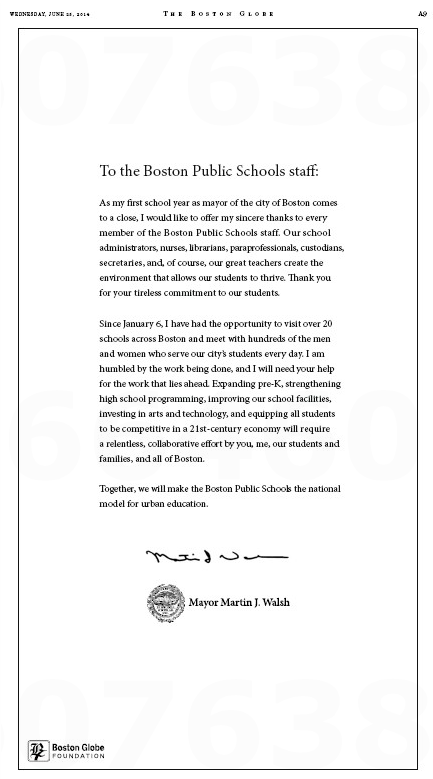
Last Wednesday, this full-page ad appeared in the Boston Globe:
That got the headscratching staff to wondering who paid for Marty’s Mash Note to the Boston Public Schools. So we sent a note to the Boston Globe Foundation (see lower left in the ad) asking just that: Did Mayor Walsh (read: Boston taxpayers) foot the bill? Did the Globe Foundation? Did no one?
And here’s what Globe lifer Ellen Clegg replied:
The Globe Foundation donated the ad to the Boston Public Schools pro bono, as a public service. When we get a request for support from organizations that fit the Foundation’s mission, we work with the Globe’s advertising department to donate pro bono print ads in space that would normally go to unpaid “house ads.” It’s a great way to engage with the community. Other recent examples of pro bono ads include the One Fund and the MLK Summer Scholars Program, which the Foundation co-sponsors with John Hancock.
(The hardquizzing staff followed up with an email that asked Ms. Clegg these questions: 1) When you donated the ad to the Boston Public Schools, did you know it would take the form of a letter from Mayor Walsh? 2) Who did the creative/production of the ad? 3) Given the ad’s content, did you have any concerns that it would look like you donated the ad not to the BPS but to Mayor Walsh, appearing to compromise the Globe’s arm’s-length relationship with him?
(We have yet to hear back.)
Meanwhile, as the redoubtable Dan Kennedy pointed out to us, the redoubtable Dan Kennedy pointed us to this piece in Commonwealth Magazine, where it seems to us Ms. Clegg told a very different story to CommonWealth Magazine (which, frankly, came late to the party):
Globe Foundation gives full-page ad to Walsh
Mayor approached CEO Sheehan for space
THE BOSTON GLOBE FOUNDATION donated a full-page ad in Wednesday’s newspaper to Boston Mayor Marty Walsh so he could thank the staff of the Boston Public Schools at the close of the school year.
Ellen Clegg, who heads the foundation, said the mayor personally asked Globe CEO Mike Sheehan for the ad space and the foundation provided it because the message was in keeping with the organization’s focus on education and literacy.
Yes, well, Ms. Clegg might want to focus on her own message(s). Clearly, she gave us a mere bag of shells.
The hardreading staff will call Ms. Clegg tomorrow and try to clarify all this, because turning your newspaper into a mayoral Make a Wish fund is a lot different from “donating an ad to the Boston Public Schools.”
On Wednesday, this full-page ad appeared in the Boston Globe:
That got the headscratching staff to wonder, Who picked up the tab for Marty’s Mash Note to the Boston Public Schools?
So we sent a note to the Boston Globe Foundation, whose logo appears lower left, asking if they could tell us if Mayor Walsh (read: Boston taxpayers) paid for the ad space or the Globe Foundation did or if any money changed hands at all.
And here’s the reply we received from Globe stalwart Ellen Clegg:
The Globe Foundation donated the ad to the Boston Public Schools pro bono, as a public service. When we get a request for support from organizations that fit the Foundation’s mission, we work with the Globe’s advertising department to donate pro bono print ads in space that would normally go to unpaid “house ads.” It’s a great way to engage with the community. Other recent examples of pro bono ads include the One Fund and the MLK Summer Scholars Program, which the Foundation co-sponsors with John Hancock.
Ms. Clegg graciously offered to talk with the hardquizzing staff and we have a call in to her.
As the hardreading staff has noted on numerous occasions, the relationship between Boston Globe/Red Sox owner John Henry and the City of Boston (read: Tom Menino) over the past several years became increasingly – and profitably – chummy, from Landsdowne Street air rights to Fenway Franks.
Boston Mayor Marty Walsh has always struck the hardreading staff as deep-down a Boston Herald kind of guy. But you can’t tell by looking at the local dailies today.
Boston Globe, Page 9:
Boston Herald: Nada thing.
Of course this logo lower left in the ad might explain that.
Subsequently, the headscratching staff sent this email to the Boston Globe Foundation:
I produce the website It’s Good to Live in a Two-Daily Town and I read with interest Mayor Walsh’s full-page ad in today’s Globe. I also noticed that the Boston Globe Foundation logo was included lower left.
Can you tell me if Mayor Walsh paid for the ad space? Or if the Boston Globe Foundation did? Or if any money changed hands at all?
When I got to chat briefly with Linda [Pizzuti, Henry’s wife] after the Chamber breakfast, she described her role at the paper as “evolving.” Is there any greater sense of what exactly her role will be yet?
Linda is fully engaged working on important issues for the Boston Globe. She is leading initiatives to activate our subscriber base connecting the Globe to the community. She is heading up the Boston Globe Foundation. And she serves on a number of internal committees that deal with real estate, circulation, social media and other business issues.
She was the driving force behind our recently launched Globe GRANT program, which gave our subscribers vouchers they are assigning to non-profit organizations for advertising space in the Boston Globe. This program has been very warmly received by charitable organizations and subscribers.
(Henry also writes in the exchange, “Mike [Barnicle] knows everyone worth knowing.” Huh.)
Anyway, we’re hoping to hear from the stately local broadsheet’s stately local do-gooders.
Did Marty Walsh (read: Boston taxpayers) pay for yesterday’s full-page ad? Did Linda Pizzuti? Mike Barnicle? Nobody?
Pick up today’s Boston Herald and here’s what you’ll find splashed across the bottom half of Page 3:
The firsty local tabloid is rightly proud of its Sigma Delta Chi Award for Deadline Reporting (Daily Circulation of 50,001-100,000) on the Boston Marathon tragedy, just as we’re sure the Boston Globe is for its First Place award for Deadline Reporting (Daily Circulation of 100,001+) on the Boston Marathon tragedy. The stately local broadsheet didn’t mention it in today’s edition, but we’ll check back tomorrow.
The Boston Globe’s Brown-beating of Downturn Scotty proceeded apace in yesterday’s edition, Page One.
Speeches paying off for Brown
In shift, he releases records; got $126k for Fox News job
MANCHESTER, N.H. — Former Massachusetts senator Scott Brown has earned hundreds of thousands of dollars since leaving office by collecting speech fees, a six-figure paycheck from Fox News, and a variety of other income, according to documents made public Friday.
Brown, who lost his 2012 bid for reelection and is now seeking a US Senate seat in New Hampshire, made 20 paid speeches for $186,000 between January 2013 and May 2014. They included a London address to the Royal Bank of Scotland for $20,000 last year, a $900 speech at the Billerica Community Alliance in October, and a $20,000 paycheck for speaking at a hedge fund conference in Las Vegas last month.
Billerica Community Alliance? $900? Seriously?
Kick-in-the-nuts graf:
As he did in Massachusetts, Brown has sought to present an image of himself as a regular guy with a pickup truck for his New Hampshire Senate bid. New Hampshire’s median household income, among the nation’s highest, is about $65,000.




 Posted by Campaign Outsider