Boston Herald: Boston Globe Sale Delayed

October 20, 2013

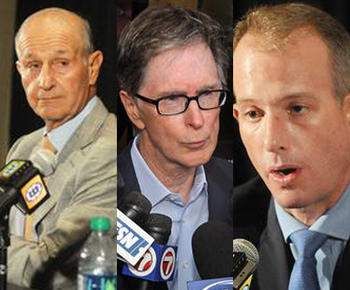
World-Series-bound Red Sox owner John Henry is also newspaper-bound Boston Globe owner John Henry.

But not so fast, says crosstown rival Boston Herald.

Globe holds off closer

Sale with John Henry slides

The John Henry era will soon begin at The Boston Globe — though not as early as originally hoped — as the broadsheet prepares to end 121611globemh02.1two decades under the control of its out-of-town overlords.

A source close to the deal told the Herald yesterday that finalizing the purchase and executing the formal transfer of the newspaper from the Times to the Red Sox owner — which had been expected to happen sometime over the weekend — likely won’t take place until next week at the earliest.

Both the Globe and a rep for Henry declined comment yesterday, and a Times spokeswoman did not return calls or emails.


Big surprise there, yeah?

But no surprise here: Others say otherwise.

From NECN:

Screen Shot 2013-10-20 at 1.44.50 AMMoney Matters: Henry to close purchase of Boston Globe Saturday

According to the Boston Business Journal, Red Sox Owner John Henry will close on his purchase of the Boston Globe this Saturday. Henry is buying the New England Media Group, including the Globe, from The New York Times. The BBJ said he’ll also pay $65-million, down from the original $70-million bid.


Tiebreaker to come.


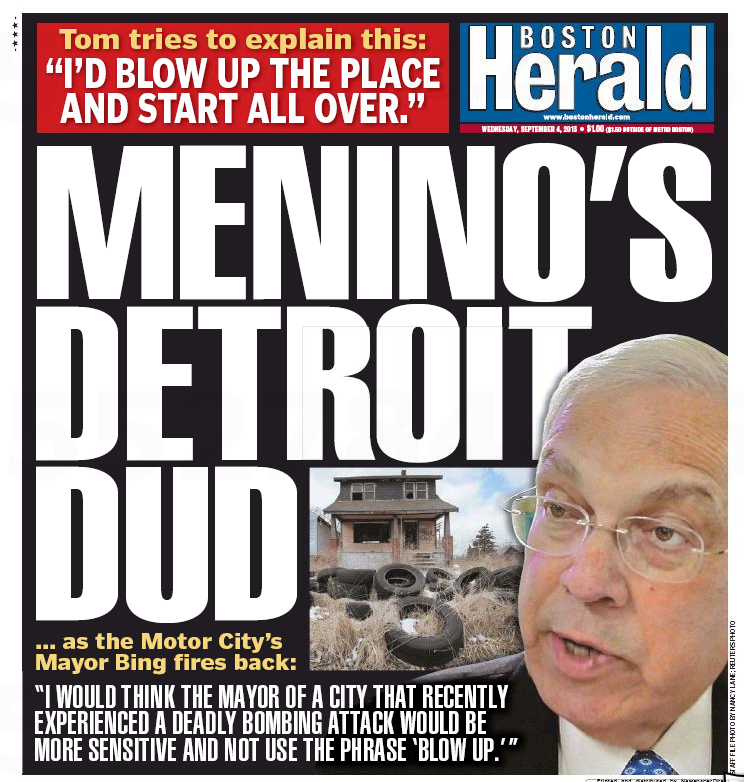
Herald: Tom Menino Gets Bombed

September 4, 2013

Our feisty local tabloid has this story all to itself today.


Picture 2


This all comes out of an interview Menino gave to the New York Times Magazine. Headline (from the print edition):

MeninoMenino’s comment bombs

Mayor’s ‘blow up’ gaffe angers Detroit officials

Mayor Thomas M. Menino admitted today it was “a poor choice of words” to declare he would “blow up” struggling Detroit and “start all over there” to fix its problems but stopped short of saying he would apologize to the Motor City’s mayor.

“It was a poor choice of words,” Menino told the Herald at an event today in the North End, referring to the comments he made in a recent New York Times interview. “Let me tell you, I look at our city, I look at their city….Cities need help.”


That got a quick response from Menino’s Detroit counterpart.

“I would think the mayor of a city that recently experienced a deadly bombing attack would be more sensitive and not use the phrase “blow up,” [Mayor Dave] Bing said in a statement.


Menino told the Herald he would call Bing not to apologize, but to “offer help.”

Just so long as it’s not elocution lessons.

Crosstown, the Boston Globe had an item about the Times interview two days ago, but noting else.

Here’s guessing it’ll stay that way.


No Sendoff for Seamus Heaney in Boston Herald

September 1, 2013

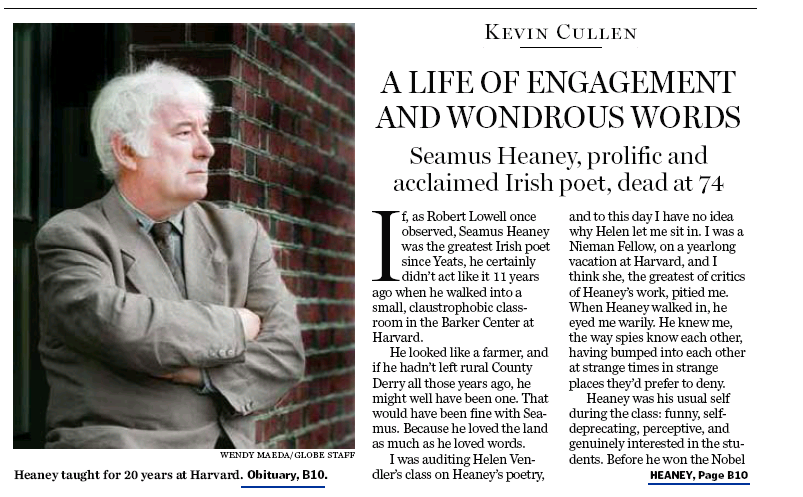
The great Seamus Heaney, considered by Robert Lowell the finest Irish poet since William Butler Yeats, died this week at age 74.

The Boston Globe gave him a front-page below the fold appreciation by Kevin Cullen . . .


Screen Shot 2013-09-01 at 12.44.29 AM


. . . and a major obituary by Joseph P. Kahn.


Screen Shot 2013-09-01 at 12.45.43 AM


Not to mention this Globe ave-atque-editorial:


Screen Shot 2013-09-01 at 12.47.49 AM


(Meanwhile, the Globe’s still-kissin’-cousin New York Times ran a Margalit Fox above-the-fold obit, along with this appraisal by Michiko Kakutani.)

The Boston Herald?

Ran nothing.

The hard reading staff will check out the Sunday Herald, but we’re cautiously pessimistic.


Al Jazeera America Has Bad News for the Boston Herald

August 20, 2013

The hardreading staff gets four newspapers delivered to the Global Worldwide Headquarters every day: Boston Globe, Boston Herald, New York Times, Wall Street Journal.

Guess which one didn’t have an ad promoting today’s launch of Al Jazeera America, the Qatar-based news organization that recently bought Al Gore’s ghostship channel, Current TV?

That’s right. The Herald.

Today’s Globe featured this ad on the back page of the A section:


Picture 2


The Journal ran the same ad, except with different colors.

The Times, meanwhile, had two Al Jazeera America ads. This full-page ad in the A section:


Picture 3


And this smaller one in the Business section.


Picture 5


The Herald got bubkes.

Of course, this happens to the feisty local tabloid all the time, as the hardreading staff has previously noted. Then again, it’s just possible that the paper rejected an effort by AJAM to purchase ad space. Maybe one of the hardhating Heraldniks who reads this will let us know.

Regardless, it’s one thing for Al Jazeera America to buy ads, and quite another to sell them. From TVNewser:

One of the complicating factors with regard to [today’s] launch: it is not clear whether AJAM will have much advertiser support.

The channel’s executive team touted its light commercial load leading up the launch arguing that it was a differentiator, but also declined to say who the flagship launch advertiser would be.


That, and cable carriage, will likely determine the fate of AJAM. But not in the near future: They’ve got some pretty deep pockets in Qatar, however you pronounce it.


Boston Globe Herald Hostage (Fire Sale Edition)

August 2, 2013

Pop Quiz: How many kidney punches can you count in the lede of this Boston Herald story today?

1STU9781.JPGThe Boston Globe drags down Times

Falling revenue at the Boston Globe’s media group only heightens the urgency for The New York Times to finally unload the newspaper — even at a disappointingly low sales price — before it can drain any more of the company’s attention and resources, newspaper experts told the Herald.

“That paper’s still struggling,” said Ed Atorino, a media analyst for The Benchmark Co. “They can’t wait to get rid of it, so I see them giving it away to somebody. It’s been going downhill, taking up a lot of management time. It’s really been a disappointing asset. I think they wanted to sell it a long time ago and couldn’t.”


The piece says Globe revenues were down 7 percent last quarter: ad revenue fell 10 percent, circulation revenue 2 percent,  other revenues 14 percent. The Herald doesn’t mention  where it got those numbers, although it attributed them to “Times execs” in a previous piece.

The feisty local tabloid also doesn’t mention its own dismal numbers during the past year: a knee-buckling 11.6% decline in daily circulation and  a 10.8% dip on Sunday.

Then again, that would just be pulling its punches.

(Answer to our Pop Quiz: Twelve.)


Herald Sox It to Globe

June 29, 2013

It’s no secret that Red Sox owner John Henry is one on the bidders lining up to buy the Boston Globe. Here’s how the Globe itself addressed Henry’s bid yesterday:

At least six groups submit bids to buy The Boston Globe

At least six groups are believed to have submitted bids to buy The Boston Globe, according to several people involved in or briefed on the offers.

The bidders, whose offers were due Thursday at 5 p.m., include several of the names previously reported to have been exploring bids, as well as Red Sox owner John Henry and his Fenway Sports Group . . .

Henry made his bid along with his New England Sports Network co-owner, Delaware North Cos. Delaware is owned by Boston Bruins owner Jeremy Jacobs.

The New York Times Co., which is selling the Globe, previously owned a stake in the Red Sox.


Leave it to the Boston Herald, however, to expose the dark underbelly of the potential deal.

4_0John Henry’s Globe bid raises fears

Sports coverage could be affected

Sports-savvy readers could be crying foul if Red Sox owner John Henry’s bid to team up with the owner of the Bruins to buy the Globe wins out, fearing the beleaguered broadsheet would shy away from hard-hitting coverage, according to media experts.

“If he owns the paper, he can give good coverage to the team,” said Edward Atorino, a media analyst with The Benchmark Company. “I know what I would do if it were my paper. I’d certainly want a bias to the positive of covering my team — come on.”


A bias to the positive of covering my team? Smooth analysis.

Of course, it’s a perfectly reasonable concern that the Herald raises, given hard times in the news industry and Henry’s past prickliness. It’ll be fun to see how far the feisty local tabloid can stretch it.

Like taffy, we’re betting.


Herald Romes Much Farther Than Globe

March 20, 2013

It’s a rare day – and therefore a noteworthy one – when the Boston Herald devotes more resources to a big story than the Boston Globe does.

Welcome to today’s edition of our feisty local tabloid gone global. Note the dateline on Margery Eagan’s column:

Vatican PopePope Francis fever catches on in Rome

ROME — The Roman Catholic Church has been losing the faithful in Italy and much of Europe for decades. Pope Francis has clearly revived interest, if only until his novelty wears off.

Yesterday, for the third time in a week, an estimated 150,000 packed St. Peter’s Square. Police were keeping order in subway stations en route to the Vatican as crowds tried to push onto nearly full trains. Streets all around the Vatican were closed to traffic. But they were filled with what looked like thousands more spectators who showed up too late to fit into the square — meaning they didn’t get here by 7:30 a.m. for a 9:30 a.m. Mass.

These thousands watched on at least a dozen Jumbotrons as Pope Francis, just before his inaugural Mass, rode about the square not in the bulletproof glass popemobile, but, unusually, in an open-air model. It allowed him to get on and off and kiss a baby and the forehead of a man who appeared disabled and smiled up at Francis’ face.


Today’s Herald also features a thumbsucker on Sean O’Malley’s elevated status after his waltz with the Great Mentioner at the Vatican conclave.

Vatican PopeObservers see O’Malley as papal adviser

Cardinal Sean P. O’Malley will return to Boston this week a more influential figure than when he left for the papal conclave late last month — with international name recognition, and possibly the prospect of a role in Rome as Pope Francis aligns his inner circle, religious experts said.

“My sense is that Sean O’Malley is happy in Boston and would not be happy at the Vatican. On the other hand, he is a close friend of Pope Francis. I wouldn’t be surprised if he has a role for Cardinal O’Malley,” said Thomas Groome, a theology professor at Boston College. “He’ll have a more enhanced role in advising and leadership than he did under Benedict. He certainly is coming home with an enhanced reputation.”

National Catholic Reporter’s John Allen Jr., whose article on O’Malley prior to the conclave helped elevate the Boston archbishop’s profile, said O’Malley has been rumored to take over as leader of the Congregation for Institutes of Consecrated Life and Societies of Apostolic Life, which manages the rules governing priests and nuns.

Meanwhile, crosstown at the Globe, today’s edition included only this on the pontiff front:

2013-03-19T141110Z_01_MBH11_RTRMDNP_3_POPEAt inaugural, Pope Francis vows to serve poor

Urges those in power to protect world

By Elisabetta Povoledo, Rachel Donadio and Alan Cowell |  NEW YORK TIMES     MARCH 20, 2013

VATICAN CITY — At the formal start of his papacy, Pope Francis offered a passionate pledge Tuesday to serve ‘‘the poorest, the weakest, the least important,’’ striking the same tones of humility that have marked the days since he was elected last week.

On a raised and canopied throne on a platform looking out from St. Peter’s Basilica to the piazza in front of it, the pope enjoined those in temporal power to protect the world and ‘‘not allow omens of destruction and death to accompany the advance of this world.’’

“Today, too, amid so much darkness, we need to see the light of hope and to be men and women who bring hope to others,’’ he added to frequent applause from some among the tens of thousands of people cramming the square and the broad avenue leading to it from the River Tiber. The Vatican estimated the number at 150,000 to 200,000.


A story plucked from the New York Times wire service?  Kinda pales in comparison with the Herald, eh?

It’s possible-to-likely the paper is splitting the cost of Eagan’s Roman gig with WGBH (where she co-hosts a radio show with Jm Braude), since she’s also reported on the papal festivities for 89.7 FM.

Either way, it’s the Herald that’s the papal tiger on this story.


Boston Retail History: Bonwit Teller Part Two

March 20, 2013

In response to our post, Local Dailies Disappear Bonwit Teller from Boston’s Retail History, splendid commenter Rick in Duxbury sent this to the hardreading staff:

If memory serves, the thing that really killed Bonwit’s was the boneheaded real estate department employee who forgot to exercise the renewal option in their lease, thus putting the iconic building on the market in the first place.


(First, full disclosure: Regarding all things retail, we routinely defer to the Missus who, as it happens, worked for Bonwit Teller as an executive shopping consultant throughout the 1980s.)

So, Rick: We think you’ve confused Bonwit’s with the boneheaded Lord & Taylor employee who forgot to renew the Boylston Street store’s lease in 2002.

The Bonwit Teller story is something else again.

The upscale retailer occupied 234 Berkeley Street (former home of the New England Museum of Natural History) from 1947 to 1987. At which point Louis Boston resided across Boylston Street, where they had a 20-year lease.

But The New England insurance company wanted to raze the block and build what became 500 Boylston Street. Louis said they’d only move if they could have Bonwit’s location.

So Bonwit Teller, conveniently motivated by a sweetheart lease, moved into the New England’s new building across the street.

From the (1988) New York Times:

The new Boston Bonwit’s is on Boylston Street in the city’s affluent Back Bay neighborhood, the location for several big stores and an increasing number of specialty shops and boutiques. It replaces a store shut down in 1987 after 30 years in a distinctive nearby building.

The new store is in a recently opened $150 million, 25-story office building designed by Philip Johnson for the New England, an insurance company. The first two floors house retailers and restaurants. Bonwit’s, which declined to say how much it had spent on the store, has 33,000 square feet of selling space, as against 24,000 in its former site.


Regardless, Bonwit Teller soon went out of business, a victim of changing retail times and shaky management.

But that doesn’t mean it should be erased from Boston’s retail history, as the local dailies have done in reporting its latest successor at 234 Berkeley, Restoration Hardware.

Better to restoration Bonwit’s into the record books, yes?


Herald Brings Brazil Nightclub Tragedy Home

January 28, 2013

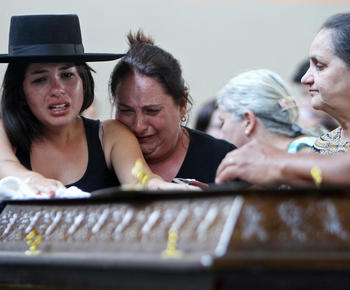
The nightclub fire that killed 233 people in Sao Paulo Santa Maria, Brazil, yesterday has, as many have pointed out, haunting similarities to The Station nightclub fire in Rhode Island a decade ago. Both Boston dailies noted the echoes in their print editions today, one much more vividly than the other.

The Globe ran the story Page One, but it was a pickup from the New York Times.

Picture 1


The Globe did toss in a couple of local references:

The disaster ranks among the deadliest nightclub fires in history, comparable to the 2003 blaze at The Station nightclub in Rhode Island that killed 100 people, one in 2004 in Buenos Aires in which 194 were killed, and a fire at a club in China in 2000 in which 309 people died. In 1942, a fire at the Cocoanut Grove nightclub in Boston killed 492 people . . . The scene recalled the 2003 fire at The Station nightclub in West Warwick, R.I., at which the rock band Great White was performing. During the show, pyrotechnics set fire to flammable soundproofing foam that lined the walls and ceiling, killing 100 and injuring 200.


The Herald coverage, though, cut much closer to home:

Picture 2


Lead piece:

Brazil Nightclub FireFire rocks Hub Brazilians, survivors of R.I.’s station

‘It’s just heartbreaking … that someone else has to go through this’

The pyrotechnic fire that killed at least 233 people in a crowded Brazilian nightclub yesterday stunned the still traumatized survivors of Rhode Island’s 2003 Station nightclub blaze and prompted prayer vigils among the Boston area’s large Brazilian community.

“It’s just heartbreaking to know that someone else has to go through this,” said Gina Russo, 45, of Cranston, R.I., a survivor of the Station nightclub fire, who has undergone 54 surgeries to date after more than 40 percent of her body was burned. She lost her fiance in the fire.

“It’s everybody’s worst nightmare,” said Aguilar Martins of 
Lynnfield, a 42-year-old Brazilian who attended a vigil at the First Brazilian Baptist Church in Charlestown. “We’re so far away, you can’t really do much about it.”


Except tell the stories as best you can.


It’s Good to Live in a Two-Times Co. Town (Paywall Edition)

December 9, 2012

As newspaper revenues continue to go down like the Hindenburg, more and more dailies are looking to erect paywalls to corral new cashflow.

Exhibit Umpteen: The Washington Post.

From David Carr’s post on the New York Times Media Decoder blog (via Politico’s Playbook):

fence-decoder-blog480Pay Wall Push: Why Newspapers Are Hopping Over the Picket Fence

When The Wall Street Journal broke the news that The Washington Post was likely to start charging for online content sometime next year, it should not have come as a surprise, but it did.

The shock had something to do with the certainty that Donald Graham, chairman of the Washington Post Company, has always displayed on the subject. He has long had serious reservations about putting the work of his company’s journalists behind a wall. According to GigaOm, he explained it in the following way to Walter Isaacson at an Aspen Institute event:

The New York Times or Wall Street Journal can say we’re going to charge, but we’re not going to charge you if you subscribe to the newspaper. The Washington Post circulates in print only around Washington, D.C., but way over 90 percent – I think over 95 percent of our Internet audience is outside Washington, D.C. We can’t offer you that print or online choice. So, the pay model would work very differently for us.

But now The Post is contemplating a model in which the homepage and section fronts will be free, but the rest will require a subscription, which is a pretty nifty way to allow for snacking while hoping that people stick around to eat.


But some who’ve gone this route aren’t getting all that many bites. Among them is NYT kissin’ cousin the Boston Globe. Here’s what Carr writes about the two:

The New York Times’s positive experience with online subscriptions is probably not one that will scale across the industry. As a national newspaper with international resources, The Times is fishing in a pool of many millions of potential readers, so the fact over a half a million of that audience has opted in is a good sign for the organization, but not necessarily for the industry.

Mr. Graham noted that The Boston Globe, the former home of the incoming Post editor Martin Baron and a high-quality publication, had just 25,000 people sign up. That is a scary low number. But it is a place to begin.


Yeah, so’s zero. That don’t make it good news.