Rule #1: Don’t trust anything Boston Globe executives say these days.
Exhibit A: Here’s what Globe CEO Mike Sheehan said on WGBH’s Greater Boston Monday night:
Mike Sheehan: Part of those options we’re considering are dividing up those [undelivered] areas and bringing in some other distributors to help and getting this solved very very fast.
Jim Braude: You couldn’t undo this and just go back to the prior company?
MS: No – no, ACI is doing a very good job in certain geographies.
Then again, there’s this in today’s lately local broadsheet:
Globe splits deliveries between two companies
After more than a week of confounding problems getting newspapers to subscribers, The Boston Globe has turned to its former distribution partner to handle about half of its home deliveries across the region, Globe chief executive officer Mike Sheehan said on Tuesday.
The deal with Publishers Circulation Fulfillment Inc. follows an unexpectedly difficult rollout for the Globe’s new distribution firm, ACI Media Group Inc., which left tens of thousands of newspapers undelivered in its first week after taking over distribution within the Boston region on Dec. 28.
So, to recap: The Globe tore the sheets with former distributor Publishers Circulation Fulfillment in order to hook up with new squeeze (the drivers) ACI Media, but now the Globe and PCF are friends with benefits.
Not to get technical about it, but Mike Sheehan seems to be telling the truth a little bit at a time.
Rule #2: Don’t expect the Boston Herald to tell you anything about the Globe delivery meltdown.
Once again, the fraidy local tabloid is a day late, dolor short. Ignoring a major malfunction by your crosstown rival is not just bad journalism, it’s bad business. But at least they’re consistent.
Rule #3: Don’t expect the Globe’s publisher to stand the gaffe.
After a long hibernation, Boston GlobeSox owner John Henry – finally – weighs in today with this mealy-mouthed Letter From the Publisher.
We apologize to our loyal readers
The Globe’s responsibility to this community is to bring it the news. I would like to share some news now about why we have failed to meet this objective for many readers over the past 10 days, how we are working to fix the problems, and a bit about the root causes.
First, I want to personally apologize to every Boston Globe subscriber who has been inconvenienced. We recognize that you depend on us, and that we’ve let you down. We’re working around the clock on a variety of fronts to solve this. To that end, I also want to thank everyone at the Globe who pitched in to get some 20,000 Sunday papers delivered last weekend.
Getting a daily newspaper to your front door is a complicated exercise in logistics . . .
And blah blah blah . . .
Helpful hint: Wear asbestos glove while reading the comments.
Rule the Last: When the paper you own goes Chernobyl, don’t turtle for 10 days, then tell us how tough your job is. It’s just not manly.
UPDATE: Totally forgot (since it’s become so routine) – no Globe today. The “delivery delay” list is down to 91, but the hardlyreading staff is still on it.
Boston GlobeSox owner John Henry gets batted around in the Boston Herald’s Inside Track today, thanks to this Eric Wilbur piece on boston.com.
Boston is Still a Red Sox Town Even if Tom Brady is King
Who rules Boston: the Red Sox or Patriots?
Ultimately, there is no clear front-runner in the debate over whether Boston has ultimately become a football town, or if it maintains its long-time status as a bastion of baseball devotees.
The correct answer is both. It’s a Red Sox town. And it’s a Patriots town.
And boston.com is a Henry town, although the piece never mentions that. Which led Track Gal Gayle Fee to mention this:
SURPRISE! GLOBE SITE CITES SOX #1
Stop the presses: “Boston is Still a Red Sox Town Even If Tom Brady Is King.”
That’s according to Boston. com, the digital arm of the Boston Globe. But nowhere in the commentary by sports blogger Eric Wilbur does he mention that the Red Sox, the Globe and Boston.com are all owned by the same man — John Henry!
Which makes Wilbur’s conclusion — that without Brady, the Patriots would be chopped liver, fanwise — somewhat suspect, don’t cha think???
Full disclosure: The hardreading staff believes that any publication owned by Henry should disclose the connection every time it reports on the Boston Red Sox or the Liverpool Football Club or Roush Fenway Racing or Fenway Park or anything Henry has purchased since we started this post. Some people we greatly respect believe we’re over-fastidious in this matter (hi, Dan!), but we’ve learned to live with that.
Then again, some have learned to live without.
Boston.com editor Tim Molloy, who has been on the job just under a month, said he has not even met John Henry, let alone been told what to write by the Sox boss. And Molloy said he saw no problem in Wilbur’s not disclosing the boss’s mutual ownership in the piece.
“I think that’s pretty well known,” he told the Track. “It’s not anything we disguise or try to keep secret. And I’ve had absolutely no contact with Mr. Henry in terms of anything editorial.”
That last, of course, is entirely beside the point. Regardless, Molloy told the Track that “if Henry’s ownership of the paper, the website and the team were disclosed in Wilbur’s piece, it should be disclosed ‘every time we write about the Red Sox.'”
Boston Globe Media Partners should launch a new vertical – maybe Clux.com? – to house all their apologies for the Globe’s kissing’ cousin, Boston.com.
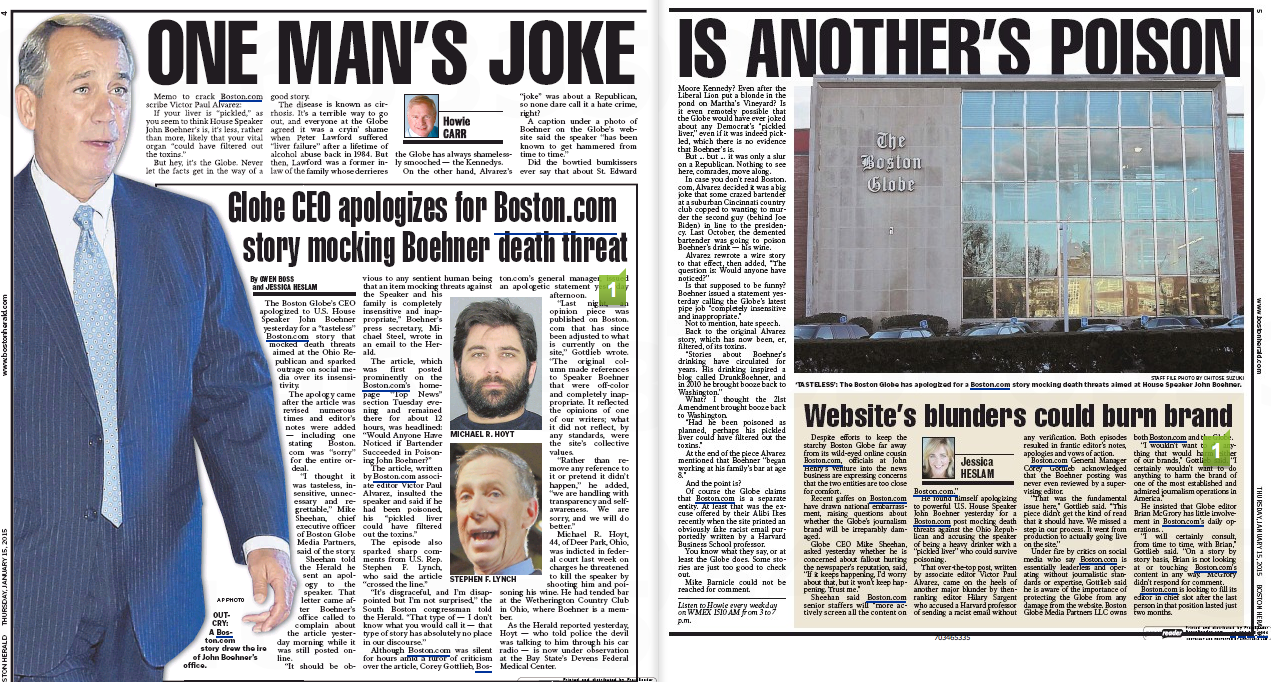
You’d think – after the t-shirt hit the fan the other week – there’d be some kind of moratorium on Boston.commentary down at Morrissey Boulevard. No such luck. Yesterday one of the Boston.comics posted a piece with the headline “Would Anyone Have Noticed if Bartender Succeeded in Poisoning John Boehner?”
It included this piece of sparkling wit (via Politico’s Hadas Gold):
The question is: Would anyone have noticed? Stories about Boehner’s drinking have circulated for years. His drinking inspired a blog called DrunkBoehner, and in 2010 he brought booze back to Washington. Had he been poisoned as planned, perhaps his pickled liver could have filtered out the toxins.
Last night, an opinion piece was published on Boston.com that has since been adjusted to what you’ll see below. The original column made references to Speaker Boehner that were off-color and completely inappropriate. It reflected the opinions of one of our writers; what it did not reflect, by any standards, were the site’s collective values. Rather than remove any reference to it or pretend it didn’t happen, we are handling with transparency and self-awareness. We are sorry, and we will do better. –Corey Gottlieb, General Manager, Boston.com
Right – “adjusted.” There’s also this: “Editor’s note: A previous version of this article made an unsubstantiated reference to the health of Speaker Boehner.”
Geez – any way they could have been a little vaguer?
Regardless, it was mother’s milk to the frisky local tabloid, which piled on with this high-priced spread (special bonus Inexplicable Green Numbers!):
The Globe, for its part, featured this blandish piece in today’s Metro section.
Look for Boston GlobeSox owner John Henry to lob a neutron bomb at Boston.com. When the dust settles, he might want to consider these recommendations from the redoubtable Dan Kennedy. Just for starters.
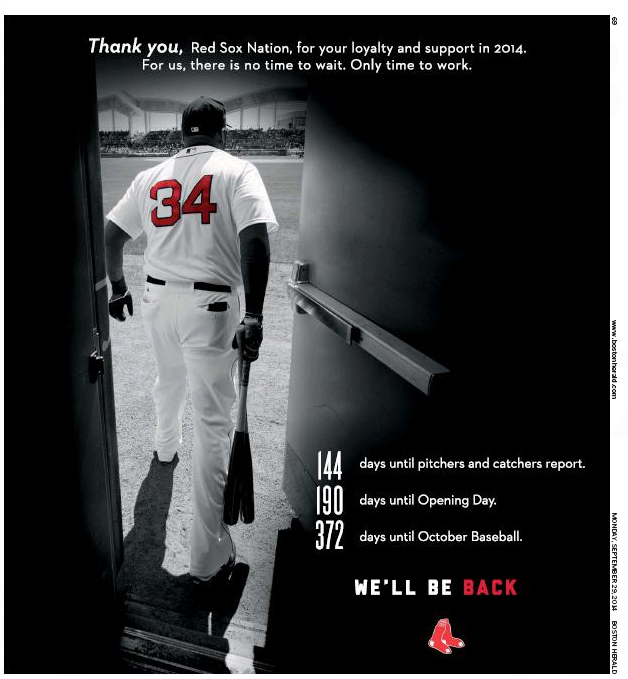
The hardreading staff was cruising through the Boston Globe Sports section this morning and amid the final final farewells to the irreplaceable Number Two, Derek Jeter, Number Two (but not at Fenway Park), we came across this full-page ad.
Our first thought: Yeah, thanks suckers.
Our second thought: Wonder if Boston GlobeSox owner John Henry ran the same ad in crosstown rival Boston Herald.
As the hardreading staff noted a couple of weeks ago, Boston GlobeSox owner John Henry is having a fling with his crosstown rival in a series of email exchanges with Herald sports scribe Michael Silverman.
First he used the frisky local tabloid to dopeslap his star sports columnist Dan Shaughnessy over his dismissal of Red Sox Nation’s unswerving devotion to the Olde Towne Team.
Yesterday, Henry opened the kimono a bit more in Silverman’s Baseball Notes column. About meddling with the Globe’s sports coverage, Henry said this:
“I don’t get involved at all with baseball coverage,” Henry said. “That would be completely inappropriate. I did get involved in pushing for Score, which was a standalone NFL section we created, and they did a terrific job on that. I’d like to see more coverage of the Revolution because I think they are becoming a more important part of the community. Soccer is becoming more important as evidenced by the reception Liverpool [the soccer club Henry owns] received here (at Fenway) this year. But I haven’t said anything to our editor or sports editor . . .
“I have not initiated a single discussion on the Sox, Liverpool or baseball. There are other areas I attend to; it’s a complicated, diverse business that is radically changing. It’s an important asset of the community.”
Translation: I don’t want to control sports coverage – I want to control sports coverage advertising.
Silverman’s Globe-go-nuts grafs:
Boston remains a two-newspaper town, a vanishing species around the country. The healthy competition between the Globe and the Herald, including but not limited to local and regional news and sports, is a boon for readers. That the Globe now uses its excess printing capacity to print the Herald highlights the changing economic realities of the two newspapers. Each strives to give its readers the best coverage possible, from the Red Sox to Beacon Hill. When it comes to sports coverage, Henry sees ESPN as the Globe’s chief competition — but with a caveat.
“In sports, the Globe competes on the Web with everyone,” Henry said. “You are one click away from the best in the world in every area. ESPN is what we are up against in sports. But you also have the damn Herald.”
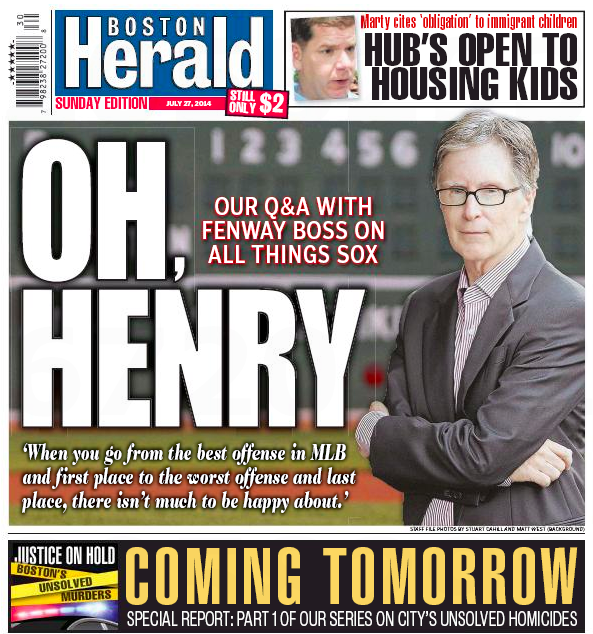
The Boston Herald’s Michael Silverman got an email interview with Boston GlobeSox owner John Henry, which, of course, was Page One news for the feisty local tabloid.
The email exchange between Silverman and Henry was pretty much what you’d expect.
Henry takes stock of perplexing Sox
The Red Sox are genuinely perplexed.
Barely more than two weeks ago, principal owner John Henry was told by his general manager that the Red Sox “are probably the best team in the division. We just aren’t playing like it.”
The reasons behind the team’s incredibly underwhelming and disappointing caliber of play for most of the first four months of the season are not clear to Henry and the front office. With the trade deadline looming Thursday, Henry and his baseball operations people have been trying to get a better handle on what’s gone wrong and discover if there’s time left to fix it.
It’s not exactly riveting stuff – when Silverman asks if the Sox are sellers or buyers, Henry replies, “We’ll see what happens (this) week.”
Ya think?
But there is one juicy item in the piece: A not-so-veiled reference to this from Boston Globe scribe (and Henry employee) Dan Shaughnessy last Sunday (reproduced in full for, well, full effect).
When did Boston go so soft on the Red Sox?
At this hour, your Boston Red Sox enjoy a friendlier environment than almost any of the 30 teams in baseball. The Sox have a chance to finish in last place for the second time in three years, win a playoff game in only one of six seasons, and still be perceived by their fans as “perennial contenders.’’ The Sox can play nine games under .500 for the first 95 games and still have a Nation of believers thinking they can win the division, or compete for the phony second wild card. Sox owners can pare payroll ($72.5 million scheduled to come off the books for next year), stay well below the coveted luxury tax threshold, and listen to regional applause while fans pay the highest ticket prices in baseball. The Sox can get folks to buy into the notion that it’s foolish to compete in the open market for the services of their best pitcher. Sox tickets and merchandise are hotter than they were at this time last summer and Pat Moscaritolo, president of a Boston tourist group, says, “For the past 10 years that I’ve been tracking visitor spending and the economic impact of the Red Sox, it’s almost unaffected by the team’s performance.’’
The Sox were positively surging with five wins in six games against terrible/mediocre teams (aggregate 21 games under .500) as they prepped for the Royals Saturday night. The KC-Boston matchup is a good one, since it sometimes sounds like the Sox want to be a middle-market team. Like the Royals of recent decades (29 years since making the playoffs), the Sox now sell the fans on “watching the kids.” Don’t people realize that EVERY team has a farm system stocked with young players who’d love to play in front of sellout crowds in the moribund final months of a season? It amazes me how soft this baseball market has become. In 1978 fans and media crushed the Sox for a 99-win season that concluded with eight consecutive pressure-packed victories. The Boston manager was unmercifully booed on Opening Day the following year. Now everything is awesome because the Boston ballpark is a tourist destination and fans fall in love with the hype of every young player coming through the system. Swell. When did we become St. Louis?
Ouch. The only thing Shaughnessy left out? That the principal owner of the GlobeSox etc. etc.
Regardless, how much fun is it that Henry employed his own crosstown rival to dope-slap his wayward minion, saying this:
“Fans continue to sell out Fenway. They’ve suffered through some really bad games this year, but they continue to show up and the mood at the park among the fans is very positive when I walk through the stands. Before Tom [Werner], Larry [Lucchino] and I arrived I believe fans had less patience.
“A loud curmudgeon I know accuses them of being soft, bad fans — but anyone paying attention knows the mood has changed at Fenway over the years. People expect good things from the Sox and really love being at Fenway. This team accomplished something very special last year therefore the fans aren’t about to not give them the benefit of the doubt.”
Love that double negative. Wonder what Mr. Shaughnessy thinks.
So, to recap for the umpteenth- hell, just see here.
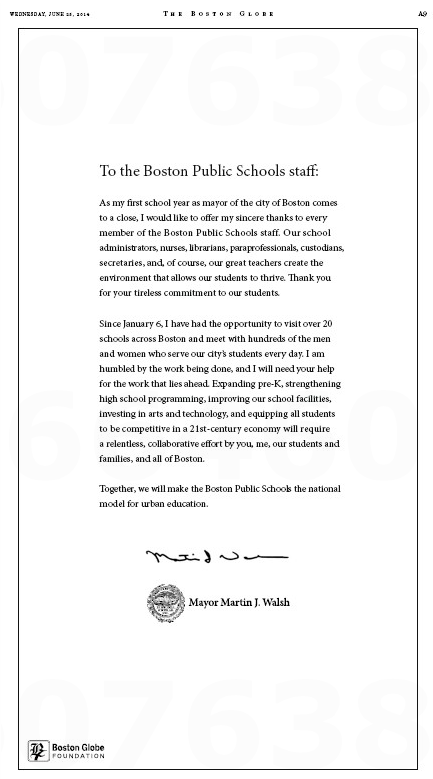
The question is this: How did Marty’s Mash Note to the Boston Public Schools wind up as a full-page ad in last Wednesday’s Boston Globe?
On Friday, CommonWealth Magazine (which came late – but smart – to the party) reported the issue thusly:
THE BOSTON GLOBE FOUNDATION donated a full-page ad in Wednesday’s newspaper to Boston Mayor Marty Walsh so he could thank the staff of the Boston Public Schools at the close of the school year.
Ellen Clegg, who heads the foundation, said the mayor personally asked Globe CEO Mike Sheehan for the ad space and the foundation provided it because the message was in keeping with the organization’s focus on education and literacy.
But Ms. Clegg had previously told the hardreading staff this:
The Globe Foundation donated the ad to the Boston Public Schools pro bono, as a public service. When we get a request for support from organizations that fit the Foundation’s mission, we work with the Globe’s advertising department to donate pro bono print ads in space that would normally go to unpaid “house ads.” It’s a great way to engage with the community. Other recent examples of pro bono ads include the One Fund and the MLK Summer Scholars Program, which the Foundation co-sponsors with John Hancock.
C’mon – “[donating] an ad to the Boston Public Schools pro bono” and kowtowing to the mayor of Boston aren’t even in the same zip code.
Regardless, Ms. Clegg perpetuated the split decision yesterday in these post-CommonWealth answers to our pre-CommonWealth questions, which took her initial explanation at face value:
• When you donated the ad to the Boston Public Schools, did you know it would take the form of a letter from Mayor Walsh?
Yes.
• Who did the creative/production of the ad?
The Globe’s advertising department.
• Given the ad’s content, did you have any concerns that it would appear you donated the ad to Mayor Walsh, raising questions about the appearance of compromising the Globe’s arm’s-length relationship with him?
The Globe’s newsroom is independent from the business side of the organization, and from the Globe Foundation, and had no involvement here.
I’m sure you’ve seen the newsroom’s recent scrub of Mayor Walsh’s hiring record (link below). I have confidence that our journalists will continue to scrutinize public officials and powerful institutions, including City Hall.
Frankly, we’re more interested in scrubbing Ms. Clegg’s record of telling the hardreading staff one thing and CommonWealth another.
From the start of John Henry’s dual ownership of the Boston GlobeSox, the paper pretty consistently ignored conflicts of interest in his business dealings with the Menino administration (see here and here). If Henry is now dancing to Marty Walsh’s tune, he should own up to that, too.
Last Wednesday, this full-page ad appeared in the Boston Globe:
That got the headscratching staff to wondering who paid for Marty’s Mash Note to the Boston Public Schools. So we sent a note to the Boston Globe Foundation (see lower left in the ad) asking just that: Did Mayor Walsh (read: Boston taxpayers) foot the bill? Did the Globe Foundation? Did no one?
And here’s what Globe lifer Ellen Clegg replied:
The Globe Foundation donated the ad to the Boston Public Schools pro bono, as a public service. When we get a request for support from organizations that fit the Foundation’s mission, we work with the Globe’s advertising department to donate pro bono print ads in space that would normally go to unpaid “house ads.” It’s a great way to engage with the community. Other recent examples of pro bono ads include the One Fund and the MLK Summer Scholars Program, which the Foundation co-sponsors with John Hancock.
(The hardquizzing staff followed up with an email that asked Ms. Clegg these questions: 1) When you donated the ad to the Boston Public Schools, did you know it would take the form of a letter from Mayor Walsh? 2) Who did the creative/production of the ad? 3) Given the ad’s content, did you have any concerns that it would look like you donated the ad not to the BPS but to Mayor Walsh, appearing to compromise the Globe’s arm’s-length relationship with him?
(We have yet to hear back.)
Meanwhile, as the redoubtable Dan Kennedy pointed out to us, the redoubtable Dan Kennedy pointed us to this piece in Commonwealth Magazine, where it seems to us Ms. Clegg told a very different story to CommonWealth Magazine (which, frankly, came late to the party):
Globe Foundation gives full-page ad to Walsh
Mayor approached CEO Sheehan for space
THE BOSTON GLOBE FOUNDATION donated a full-page ad in Wednesday’s newspaper to Boston Mayor Marty Walsh so he could thank the staff of the Boston Public Schools at the close of the school year.
Ellen Clegg, who heads the foundation, said the mayor personally asked Globe CEO Mike Sheehan for the ad space and the foundation provided it because the message was in keeping with the organization’s focus on education and literacy.
Yes, well, Ms. Clegg might want to focus on her own message(s). Clearly, she gave us a mere bag of shells.
The hardreading staff will call Ms. Clegg tomorrow and try to clarify all this, because turning your newspaper into a mayoral Make a Wish fund is a lot different from “donating an ad to the Boston Public Schools.”
On Wednesday, this full-page ad appeared in the Boston Globe:
That got the headscratching staff to wonder, Who picked up the tab for Marty’s Mash Note to the Boston Public Schools?
So we sent a note to the Boston Globe Foundation, whose logo appears lower left, asking if they could tell us if Mayor Walsh (read: Boston taxpayers) paid for the ad space or the Globe Foundation did or if any money changed hands at all.
And here’s the reply we received from Globe stalwart Ellen Clegg:
The Globe Foundation donated the ad to the Boston Public Schools pro bono, as a public service. When we get a request for support from organizations that fit the Foundation’s mission, we work with the Globe’s advertising department to donate pro bono print ads in space that would normally go to unpaid “house ads.” It’s a great way to engage with the community. Other recent examples of pro bono ads include the One Fund and the MLK Summer Scholars Program, which the Foundation co-sponsors with John Hancock.
Ms. Clegg graciously offered to talk with the hardquizzing staff and we have a call in to her.
As the hardreading staff has noted on numerous occasions, the relationship between Boston Globe/Red Sox owner John Henry and the City of Boston (read: Tom Menino) over the past several years became increasingly – and profitably – chummy, from Landsdowne Street air rights to Fenway Franks.
Boston Mayor Marty Walsh has always struck the hardreading staff as deep-down a Boston Herald kind of guy. But you can’t tell by looking at the local dailies today.
Boston Globe, Page 9:
Boston Herald: Nada thing.
Of course this logo lower left in the ad might explain that.
Subsequently, the headscratching staff sent this email to the Boston Globe Foundation:
I produce the website It’s Good to Live in a Two-Daily Town and I read with interest Mayor Walsh’s full-page ad in today’s Globe. I also noticed that the Boston Globe Foundation logo was included lower left.
Can you tell me if Mayor Walsh paid for the ad space? Or if the Boston Globe Foundation did? Or if any money changed hands at all?
When I got to chat briefly with Linda [Pizzuti, Henry’s wife] after the Chamber breakfast, she described her role at the paper as “evolving.” Is there any greater sense of what exactly her role will be yet?
Linda is fully engaged working on important issues for the Boston Globe. She is leading initiatives to activate our subscriber base connecting the Globe to the community. She is heading up the Boston Globe Foundation. And she serves on a number of internal committees that deal with real estate, circulation, social media and other business issues.
She was the driving force behind our recently launched Globe GRANT program, which gave our subscribers vouchers they are assigning to non-profit organizations for advertising space in the Boston Globe. This program has been very warmly received by charitable organizations and subscribers.
(Henry also writes in the exchange, “Mike [Barnicle] knows everyone worth knowing.” Huh.)
Anyway, we’re hoping to hear from the stately local broadsheet’s stately local do-gooders.
Did Marty Walsh (read: Boston taxpayers) pay for yesterday’s full-page ad? Did Linda Pizzuti? Mike Barnicle? Nobody?



 Posted by Campaign Outsider





 It's Good to Live in a Two-Daily Town