Boston Herald: Most of the Hub a Red Light District

March 7, 2019

The hardreading staff has long held that the traffic lights in Boston must have been timed by Joe Cocker.

Unlike a real city such as New York – where one can routinely drive up, say, Madison Avenue for 10, 20, 30 blocks without stopping – making two consecutive lights in this town qualifies as a Dear Diary day.

The Boston Herald certainly gets that, as today’s front page attests.


Driving drivers nuts graf in the piece by Sean Philip Cotter and Meghan Ottolini:

“You have three lights in 50 yards, and the middle one will be green and the other two won’t. Then the opposite. No one’s going anywhere,” Uber driver Felipe Rios told the Herald last week, voicing a common gripe about constant stops and starts that he and other drivers see as unnecessary.


The gridlock grid extends from most of Mass. Ave to stretches of road on both sides of the Greenway to roads around TD Garden and Congress Street, according to this handy chart.


Sadly, unsticking those points doesn’t seem to be a top priority for city officials.

A recent national study found Boston has the worst congestion in the country, worse than even Los Angeles. But [City transportation chief Gina] Fiandaca said making traffic in Boston move faster isn’t her top concern.

“Our pedestrian safety programs are our No. 1 priority,” Fiandaca said, citing concerns that synced lights lead to speeding and put pedestrians and cyclists in danger.


It’s worth checking out the whole report, including this video and even some whining by Uber drivers.

If you’re in your car, of course, only at red lights.


MA Treasurer Didn’t Stiff Herald on Lost Property List

March 4, 2019

As the hardreading staff pawed through yesterday’s Boston Globe, we came upon this “Notice of Names of Persons Appearing to be Owners of Unclaimed Property” – a 54-page free standing insert produced by the Office of the State Treasurer and Receiver General.

It’s the state’s semi-annual list of tens of thousands of people who might have unclaimed funds in the possession of the Massachusetts Treasury.


Not to get technical about it, but that’s no Amy – as far as we can tell it’s the very talented local actress Celeste Oliva, about whom our kissin’ cousins at Campaign Outsider have written several times.

Regardless, imagine our total lack of surprise when we turned to the Boston Herald and found – no unclaimed property list in the thirsty local tabloid. Free standing insult.

So we called the office of Treasurer Deborah Goldberg to ask why she skipped the Herald, whose readers are for the most part a) Massachusetts residents, and b) easily as forgetful as Globe readers.

Deputy communications director Emma Sands was kind enough to straighten us out: The insert will run in the Herald this coming Sunday; this is the second time the Treasurer has run the insert in the two Boston dailies on consecutive Sundays; and the insert will run in a variety of regional papers in the coming weeks.

Office of the Treasurer: An equal-opportunity advertiser.

P.S. The hardsearching staff did not find its name on the list, alas.


Jed Gottlieb Is Last Pop Music Critic at a Boston Daily

March 1, 2019

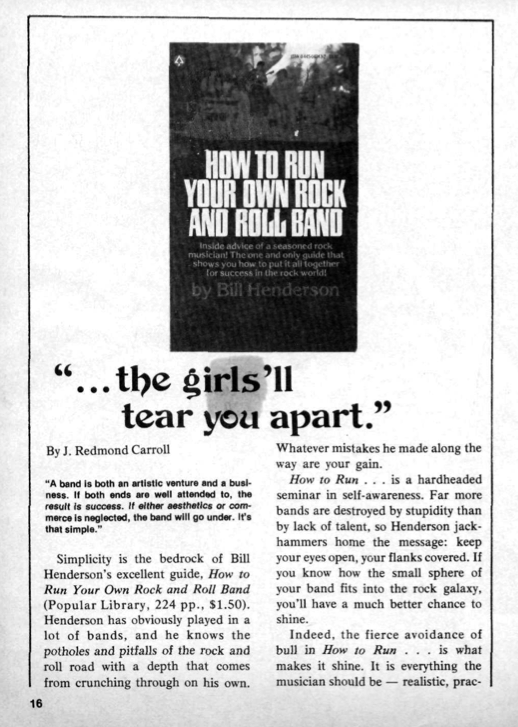
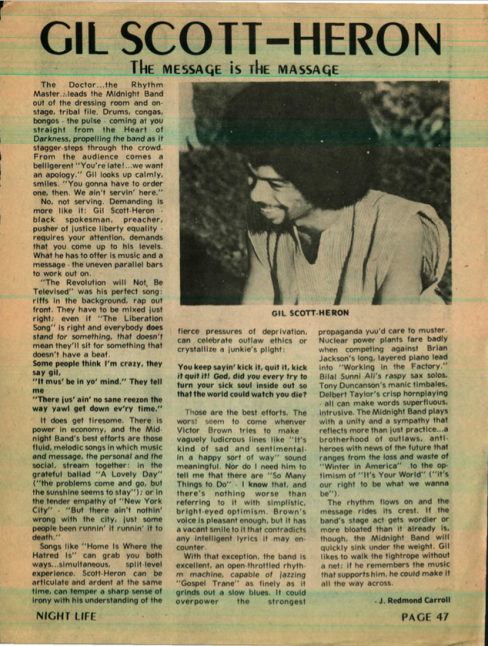
When I first arrived in Boston in the fall of 1974 (“Hey, people, what’s with the forced busing? Are you meshugge?”), you couldn’t spit without hitting a music magazine. Pop Top, Rock Around the World, Night Life, Musicians Guide, Nightfall – they were all over town.

And there were so many music critics, even I was one, writing for all of the above under severel variations of my name.

Representative samples:


If you didn’t pay close attention at the time, you almost wouldn’t notice I knew virtually nothing about music.

Now comes the Boston Herald’s Jed Gottlieb – the last pop music critic at a major Boston newspaper – to survey the wreckage of local music coverage in a piece for Fast Company headlined “The web is killing newspaper arts critics like me. Why that matters.”

This is nuts graf:

The vast majority of daily papers cover a fraction of the concerts, albums, films, TV shows, theater productions, and gallery and museum exhibits than they did 10 years ago. A quick look at the rolls of professional organizations–the American Theatre Critics Association, the Jazz Journalists Association, the National Society of Film Critics–shows less than 10% of members holding full-time jobs at papers, down from approximately 50%, depending on the organization, around 2000.


Gottlieb says the internet – which has played a major role in the decline of newspapers over all – is no substitute for what it has muscled out. “Online arts outlets, from full-fledged magazines to blogs run by a single person . . . produce vital, smart, passionate work, but they can’t replace the loss of arts coverage at papers.”

Or the beneficial side effects of newspaper arts coverage.

Arts writers provide a historical record of their beat like any other reporter. When holes start appearing in that historical record (or when it is abandoned completely), arts organizations can suffer. Newspaper coverage serves as promotion for community theater companies, small galleries, unknown rock bands, and others without PR or advertising budgets. Both authors and musicians have told me print reviews spark interest from publishers and record labels, even when sales lag.


In the end, Gottlieb says, what is lost goes beyond the “stumble-upon effect” of newspapers, in which readers encounter arts coverage on their way to, say, the sports pages. It’s also this: “Every piece of good arts writing dips, if ever so slightly, into the human experience, into what it means to be alive. No piece of fantasy football draft advice or gossip item about [Miley] Cyrus’s marriage can do that.”

Check out the whole piece. It’s good arts writing.


Globe Tracy Miner Update Missing Bryon Hefner Link

February 27, 2019

From our Late to the Party of the First Part desk

Nice cameo in yesterday’s Boston Globe of legal eagle Tracy Miner’s flight from her old law firm to her own.

Lawyer ‘energized’ with starting own firm

Tracy Miner would tell you that there aren’t many woman-owned law firms that specialize in criminal work.

That’s probably true. But you know what’s also rare? Lawyers who start their own firms while they’re in the midst of one of the city’s biggest white-collar criminal trials.

Miner can claim both honors. She launched Miner Orkand Siddall LP earlier this month, just as the Insys Therapeutics trial was getting underway. The racketeering case revolves around federal prosecutors’ claims that Insys executives improperly marketed the painkiller Subsys to doctors. Miner represents Mike Gurry, a former vice president at the drug company and one of the defendants in the case.


Jon Chesto’s Bold Types piece also mentions Miner’s defense counseling for “state lawmaker Vincent Piro, who had been accused of attempted extortion involving two liquor licenses that a developer sought for the Assembly Square Mall in Somerville” and “John Connolly, who was charged with taking bribes and tipping off James ‘Whitey’ Bulger to a secret federal indictment that enabled him to flee and remain on the run for 16 years.” (Piro got off; Connolly obviously did not.)

But the normally buttoned-down Chesto inexplicably fails to mention Miner’s highest profile current client: Bryon Hefner, the estranged husband of former State Senate President Stan Rosenberg. Last we saw, Hefner – who’s been accused by several men of sexual assault – goes on trial March 25.

Not exactly a minor omission. Considering Chesto’s track record, though, give him a mulligan, eh?


Two Shades of Harold Brown in Boston Dailies’ Obits

February 26, 2019

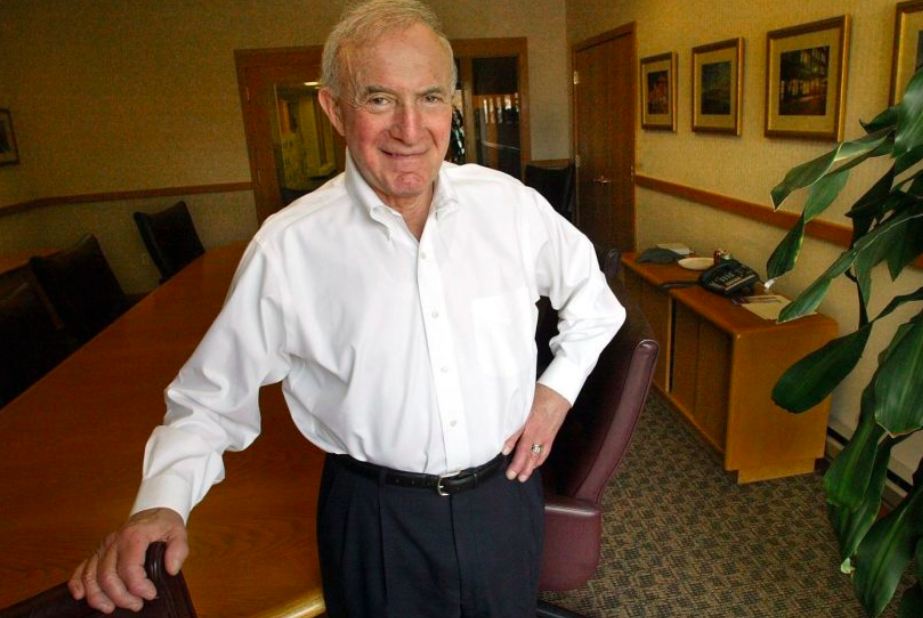
In the eyes of some Bostonians, real estate magnate Harold Brown, who died on Sunday at the age of 94, was a legendary slumlord; to others he was a storied landlord and philanthropist.

In the local dailies he was both – but in separate papers.

The first sendoff came in yesterday’s Boston Herald, with the main source for Sean Philip Cotter’s piece being Brown’s rabbi.

Storied landlord Brown dies at 94

Boston native built real estate empire

Harold Brown, the storied Boston landlord who turned one small apartment building into a sprawling real estate empire, has died, according to his rabbi. He was 94.

Brown, who retired from his position atop Hamilton Co. at age 93 last year, amassed billions of dollars worth of Boston-area property over more than six decades in the real estate business and created a charitable foundation that gave to local causes.


Today the frothy local tabloid features this piece on the Obituaries page, which described Brown as being “[k]nown for his quick wit, no-nonsense approach and generosity.” But apparently that wasn’t enough hagiography for the Herald, because Howie Carr also weighs in today with this mash note.

Harold Brown: Hard worker, veteran, friend
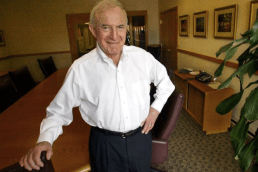
Harold Brown was a friend of mine.

He was good to me, my family, and a lot of other people. Talk about up by the bootstraps — his mother was a fortuneteller, that’s how she put food on the table during the Depression. He was a veteran of both World War II and Korea.

When he died on Sunday, at age 94, Harold Brown was probably worth well over $1 billion. He had long ago set up a giant charitable foundation. If you walked through the door of his modest offices on Brighton Avenue with your hand out, chances are, you and your group got taken care of.


The rest of the column is classic whataboutism: Everyone greased politicians, Brown just forgot to delegate his bribery. Hey! – the Kennedys were slumlords too. That 75 State Street scandal? Brown was the victim of Whitey Bulger, not the scammer.

And etc.

Crosstown at the Boston Globe, Brown’s life is a very different story, although Bryan Marquard’s obit starts off in standard style.

HAROLD BROWN 1925-2019

Hard-driving developer reshaped housing

Harold Brown liked to tell the story of growing up so poor that his immigrant mother padlocked the icebox between meals to keep her seven hungry children from pilfering food the family would need for its next meal.

Years later he was faring better. In the mid-1950s, fresh from the success of building a doughnut shop chain, he bought his first rental property — a Commonwealth Avenue apartment building. One purchase led to another as he created a formidable real estate empire that his company estimates at $2.3 billion.


The Globe obit gives a more straightforward recounting of Brown’s legal woes and financial shenanigans, from a federal bribery conviction in 1986 to his 1991 filing for bankruptcy protection when he was $650 million in debt.

But the Globe also gives him his due on the business side (“At one point in the 1980s . . . Mr. Brown’s holdings were so expansive that he estimated he collected rent from one of every 15 tenants in Greater Boston”) and on the philanthropic front, from his establishing The Hamilton Company Charitable Foundation and contributing to Franciscan Children’s to rescuing the Coolidge Corner Theatre and donating a $2.3 million building to house the Fenway Community Health Center.

Taken all together, that’s exactly why you want to live in a two-daily town.


Boston Herald Comic Mocks Globe’s Comic Stripping

February 22, 2019

As the hardreading staff has diligently chronicled, the Boston Globe joined dozens of other newspapers in dumping Non Sequitur for inviting Donald Trump to do something anatomically impossible in its comic strip last week.


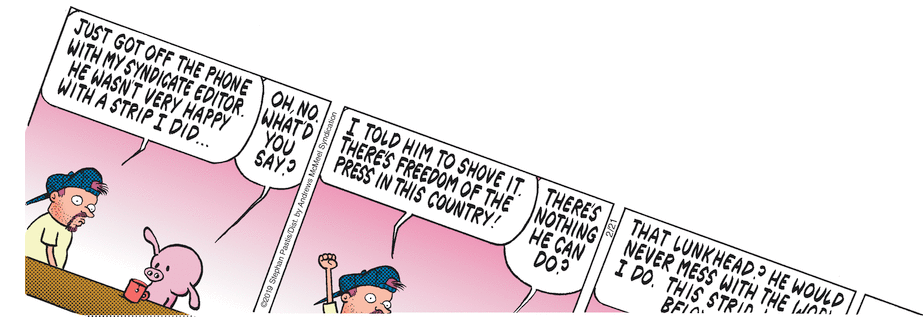
In yesterday’s Boston Herald comics page, Pearls Before Swine offered this commentary.


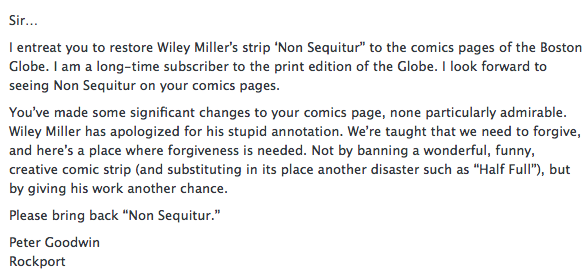
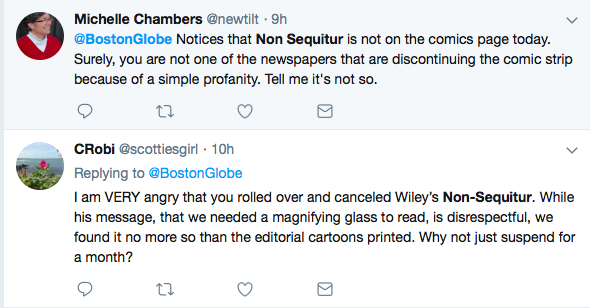
Beyond that, Two Daily Town has received several protests to the Globe’s defenestration of Non Sequitur.

Draw, as it were, your own conclusions.


Boston Globe Finally Gets Zippy, Dumps Non Sequitur

February 14, 2019

As the hardreading staff has previously noted, the Boston Globe had no immediate reaction to last Sunday’s Non Sequitur comic, which contained what was widely described as a “profane and vulgar” message to Donald Trump inviting him to do something, well, anatomically impossible.


All week newspapers have been busy dropping the strip (The Daily Cartoonist stopped counting at 45), and today the Globe followed suit with this Page 2 editor’s note.


So, instead of this on today’s comics pages . . .


Globe readers got this.


If Non Sequitur had to go (which, in truth, it didn’t), Zippy the Pinhead is an excellent replacement.

(To be sure graf goes here)

To be sure, there were a couple of protests on Twitter.


But that’s pretty much all the blowback we saw.

According to the editor’s note, the Sunday Globe will continue to stiff Zippy, opting instead for Half Full, which is, to be fair, half funny.

Hey – six out of seven Zippys ain’t bad.


Boston Globe Tells President ‘Go F— Yourself’ Part 2

February 12, 2019

As the hardreading staff noted yesterday, the strip has hit the fan over Wiley Miller’s Non Sequitur comic on Sunday, which featured this smash note for Donald Trump (it’s now been erased from the web version).


That caused a number of papers to drop the strip, including the Richmond Times-Dispatch, Butler (PA) Eagle, Orlando Sentinel, the Sun Sentinel of South Florida, the Post Bulletin of Rochester, MN, the Post-Standard of Syracuse, the Columbus Dispatch, and . . . well, tally them yourself here.

But not, as yet, the Boston Globe.

So we tweeted this a couple of hours ago to Globe editor Brian McGrory.


So far, no reply.

All this mishegas coincides with yesterday’s launch of the expanded Globe comics pages, which now look like this.


As it happens, the four restored comics – Mother Goose & Grimm, Bizarro, Rose Is Rose, and Adam @ Home – share the kiddie table on the right with Non Sequitur.


Memo to Globe readers who voted for Rose Is Rose and Adam@Home: Here’s what you brought back to the party.


When you could’ve had this . . .


. . . and this.


As Indiana Jones might say, you chose poorly.


Boston Globe Tells Donald Trump to ‘Go F— Yourself’

February 11, 2019

Well the strip has really hit the fan over Wiley Miller’s Non Sequitur comic on Sunday, and the Boston Globe is in it up to its eyeballs.

Yesterday’s Non Sequitur depicted this color-it-in “Bearaissance” with Leonardo Bear-Vinci. (Image from Globe e-paper.)


Problem is, tucked into the middle of the strip was this exhortation to Donald Trump.


As we write this, two newspapers – the Richmond Times-Dispatch and the Butler Eagle – have dropped the strip, and the Twitterverse is relatively calm. We doubt it will remain that way.

And we look forward to the Globe’s reaction to the rumpus. Feels like a lose-lose, no?


Boston Globe Go-bituaries Now a Subsidiary of NYT

February 10, 2019

Three months ago the Boston Business Journal’s Don Seiffert reported (pay wall) that the Boston Globe had offloaded more staff and outsourced more content.

Boston Globe to lay off 15, outsource death notices

The latest round of layoffs at the newspaper includes 10 longtime employees in the classified department, and plans to outsource the “Remembered” business that prints death notices.


Then again, by the look of the Globe’s obituary pages nowadays, you’d think that they’ve been outsourced as well.

Start with Friday’s edition, which featured six obits across two pages – five of them from the New York Times, one from the Associated Press.


(To be sure graf goes here)

To be sure, you’d expect the Globe to pick up Christine Kay, editor on prizewinning Times projects, dies at 54 from the Times. Ditto for John Dingell Jr., a House ‘bull’ who served the longest, dies at 92.

But also a Times obit for Frank Robinson?

Seriously?

It’s true that Globe death beat reporter Bryan Marquard has had his hands full lately with the passing of legendary WBZ-AM anchorman Gary LaPierre and longtime Globe editor John S. Driscoll. But nobody in the Sports department could compose a sendoff to Robinson, Hall of Fame slugger and baseball’s first black manager? Geez.

Next up: yesterday’s edition of the Globe, which featured five obits – four from the Times (including Albert Finney), one from the Washington Post. Again, no one from the Arts squad had an obit prepared for the 82-year-old British stage and film actor? Double geez.

(To be fair graf goes here)

To be fair, Dan Shaughnessy penned a nice tribute to Robinson in his picked-up pieces column today. Don’t hold your breath for something similar on Finney.

Today’s Globituaries run true to form – four from the Times, two from AP.


(To be clear graf goes here)

To be clear, it’s no surprise that even a major metropolitan daily would pull most of its obits from the wire services. In the case of the Globe, however, it’s yet another symptom of the slow-motion decline of a once-robust newspaper.

Maybe not newsworthy, but certainly noteworthy.