But the Globe has at the same time failed to acknowledge its financial relationship with Total Wine, which has spent tens of thousands of dollars on advertising in the $tately local broadsheet.
Latest example: Yesterday’s Page One piece on the pushback to relaxing alcohol regulations. Buried in the final grafs was this:
Businesses, meanwhile, are prepared to spend handsomely to push measures that benefit them. The Total Wine & More chain, for example, just launched a large public relations campaign urging the task force and the Legislature to allow alcohol retailers to issue coupons and loyalty cards.
At that point you’d think the Globe might mention this ad that ran three pages later.
But no.
Then again, not everyone finds the Globe’s non-disclosure problematic. After our initial post, the redoubtable Dan Kennedy sent us this message.
We yield to no man in our respect for Mr. Media Nation, but . . .
One final note: Before you pooh-pooh the hardtsking staff, consider the Globe’s totally egregious pom-pom reporting of the recent Citgo sign rumpus, during which the paper raked in easily a hundred thousand dollars in feel-good ads for the Kenmore Square icon without disclosing its financial interest in the matter.
Total Wine & More is waging total war on the nation’s alcohol laws — and Massachusetts is the new front line.
The largest retailer of beer, wine, and liquor in the country, Total Wine has successfully challenged longstanding alcohol laws in numerous states, tilting the marketplace to its advantage through a mix of litigation, lobbying, and rallying support from customers . . .
In Massachusetts, Total Wine has sued to invalidate a state regulation that prevents retailers from selling alcohol below cost, a common practice in other industries. The company is also about to launch a public relations campaign here challenging a state rule prohibiting alcohol retailers from issuing discount coupons and loyalty cards. It has submitted the proposed changes to a task force convened by Treasurer Deborah Goldberg to streamline the state’s alcohol laws.
Here’s the interesting part: Nowhere in the Globe piece is there any mention of the tens of thousands of dollars the $tately local broadsheet has raked in from Total Wine ads over the past few months.
During the past year the hardreading staff has painstakingly noted what must be hundreds of thousands of dollars worth of Citgo ads like this one that have run in the Boston Globe.
And yet . . .
Never once in its coverage has the $tately local broadsheet mentioned the paper’s financial interest in the survival of the Kenmore Square icon.
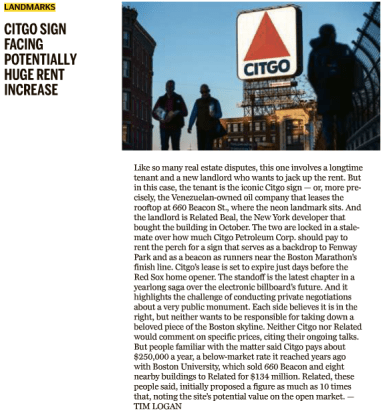
The Citgo sign will remain atop its longtime home in Kenmore Square after the petroleum company reached a deal with its new landlord Wednesday, ending a months-long standoff that had threatened one of the most recognized landmarks of the Boston skyline.
The fate of the rooftop sign had been in question since last year, when the building that hosts it was sold by Boston University to Related Beal, a New York-based development company.
(To be fair graf goes here)
To be fair, the piece by Adam Vaccaro and Tim Logan does include a sort of drive-by disclosure:
The controversy emerged last fall soon after Related Beal bought a total of nine buildings in Kenmore Square from BU for $134 million. Believing its old lease terms of $250,000 to be far below current market rates, the new landlord had wanted Citgo to pay as much as 10 times that amount.
Citgo had previously countered with an offer to pay $500,000, and had launched a public campaign to rally support behind the sign.
Pretty limp, Globeniks. And pretty sad you’re not willing to do the right thing and disclose your financial interest in this story.
But maybe that’s consistent with what editor Brian McGrory said about another recent adberation, which he labeled “part of a larger campaign that is important to the ad client and significant to the Globe.”
The $tately local broadsheet has run numerous news reports on the sign’s endangered status and numerous Citgo-purchased ads like this one pleading for the sign’s protection.
(The hardcounting staff previously estimated that Citgo has spent five figures on Globe ads. We’re a moron. It’s probably more like $200,000.)
In response to the hardtsking staff’s post yesterday that the Boston Globe was slowly becoming a sort of Adbnb after pimping out its front page on Tuesday and failing to label an editorial-looking ad on Wednesday, splendid reader Mark Laurence submitted this comment:
I don’t get your point. What is it about the Total Wine ad that doesn’t look like an ad to you? Did the graphics look too nice? There wasn’t a single sentence of text on the whole page, something you’d expect in a news story. If you want to complain about fake ads, how about the occasional Herald “road trips” to Florida or some other place that include advertising slogans and graphics in the middle of their reporter’s copy?
Well said, and an excellent opportunity to express some of the things we should have included in the original post.
All reasonable questions, Mark. I know it looks like an ad (although the Total Wine typeface feels kind of similar to Globe section headers), and there’s no text other than merchandise listings, etc.
But . . .
The Globe has traditionally labeled full-page ads that looked a lot more like ads with ADVERTISEMENT ADVERTISEMENT ADVERTISEMENT across the top of the page. Beyond that, newspapers are getting into so many other businesses (e.g. the New York Times: Travel agency, educational institution, retailer, conference center . . . see here for further details), it could easily be the Globe selling wine on that page.
My point is this: Stealth marketing erodes editorial credibility incrementally, not all at once. Sort of the way authoritarianism erodes democracy, except not as serious. I’m more concerned with the Globe’s BMC sellout than any relaxation of ad labeling, but that doesn’t mean I don’t care about the latter.
As for the Herald, I’ll keep an eye out for the next time the paper sheds an adificial light on the Sunshine State.
That’s all for now. But more, we’re guessing, to come . . .
Globe Editor McGrory Defends Placement Of Front-Page Boston Medical Center Ad
The print edition of [Tuesday’s] Boston Globe includes a banner advertisement that appears above the nameplate at the very top of the page. The ad, for Boston Medical Center, promotes that institution’s addiction services. The placement is unusual enough to have prompted a message to the staff late Monday night from Globe editor Brian McGrory:
Just a heads up to everyone that we have an unorthodox ad on the front page of tomorrow’s print Globe. There’s a copy of it at the bottom of this email. As you’ll see, it’s the same shape and size as our regular strip ads on the front, but it’s at the top of the page rather than the bottom.
We didn’t permit this lightly. The cause of fighting addiction is a noble and vital one. The institution involved, the Boston Medical Center, plays an important role in our community on this and many other issues. And we don’t intend this to be a regular ad position. This is part of a larger campaign that is important to the ad client and significant to the Globe.
Any issues or questions, feel free to raise or ask. Otherwise, thanks as always for your commitment to great journalism.
Brian
So the commitment to great journalism includes accommodating what’s “important to the ad client and significant to the Globe.”
Because they’re both on the side of the angels, right?
Except . . .
Yesterday’s edition of the Globe makes the $tately local broadsheet look like it’s on the side of the angles.
From Wednesday’s Food section, what at first glance looks like a two-page editorial spread:
Wait – where’s the ADVERTISEMENT ADVERTISEMENT ADVERTISEMENT at the top of page G3?
Apparently in someone’s desk drawer at the Globe.
(To be sure graf goes here)
To be sure, the hardtsking staff can be a bit over-fastidious at times. But still, you have to wonder: How often will what’s important to the ad client and $ignificant to the Globe now dictate the aditorial content of the paper?
Or is the Globe content merely to be the Adbnb of whatever renters come its way?
To be sure, $25,000 is lunch money at the John Henry Gazette, but it’s lunch money the paper should disclose whenever it moans about the Citgo sign’s ultimate fate.
(To be clear graf goes here)
To be clear, it’s not the fault of Globe reporter Tim Logan that his many Citgo sign pieces have lacked disclosure. The fault lies with the Globe’s editors.
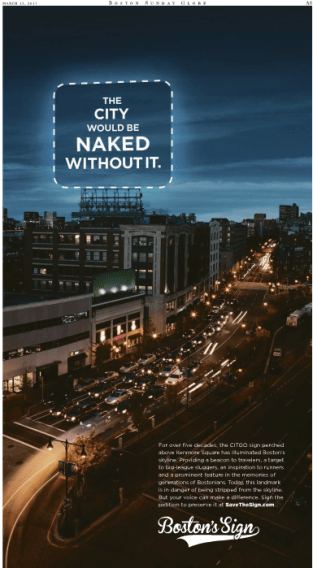
Regardless, given the latest assault on the Kenmore Square icon, it’s not unreasonable to expect there will be more ads forthcoming from the Boston’s Sign campaign. Oh, wait – like this full-page ad thatcoincidentally appeared in yesterday’s Globe.
Here’s something else that’s not unreasonable: To expect the Globe to disclose its financial interest in the Citgo sign whenever the paper covers that story.
As the hardreading staff has previously noted, Boston BFF (Big Fat Fundsucker) General Electric has a penchant for running full-page ads in the Boston Globe but not the Boston Herald.
Exhibit Umpteen, from Monday’s $tately local broadsheet.
That’s a follow-up to this GE spot on Sunday night’s Academy Awards broadcast.
Millie Dresselhaus, the first woman to win the National Medal of Science in Engineering, died on February 20th, one week before her TV spotlight ran.
So good for GE to memorialize her in print.
But c’mon, GEniks – show some love for the thirsty local tabloid, yeah?
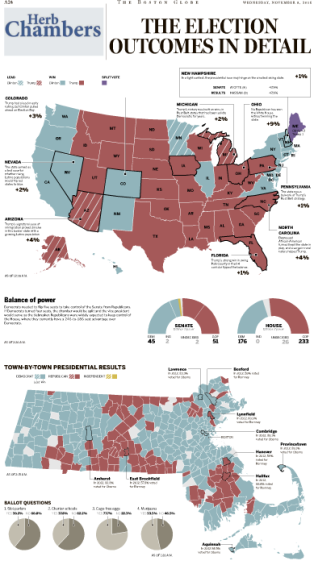
Then there was this in yesterday’s Election Hangover edition of the paper.
Apparently, the Globe is willing to slap an advertiser’s logo on virtually any piece of editorial content. (See also how Suffolk University and Steward Health Care colonized the Globe’s Capital section a while back.)
But . . . Herb Chambers? On an electoral map? What – we’re supposed to drive across the border before president-elect Donald J. Trump gets a chance to wall us in?
Then again, don’t look for logic from the Globe nowadays. Just logos.
As our kissin’ cousins at Campaign Outsider have noted, virtually every ad campaign for Legal Sea Foods over the past several years has been equal parts puerile and unfunny. But the current Berkowitz for President effort stands out for its excessively bad taste.
Back in March, there was this ad that drew protests from numerous quarters.
Last week the big guffaws came from the size of Donald Trump’s hands. Now comes this full-page ad in today’s Boston dailies.
Note that once again the Boston Herald has marked this “Advertisement,” and once again the Globe has not. Who ever imagined the thirsty local tabloid would be more fastidious than the $tately local broadsheet?
Regardless, Roger Berkowitz is getting hustled by his fancy-pants New York ad agency, DeVito/Verdi. In this case, he’s the fish.


 Posted by Campaign Outsider










 It's Good to Live in a Two-Daily Town