Over the past two days the local dailies have wishboned those closest to Boston Mayor Marty Walsh.
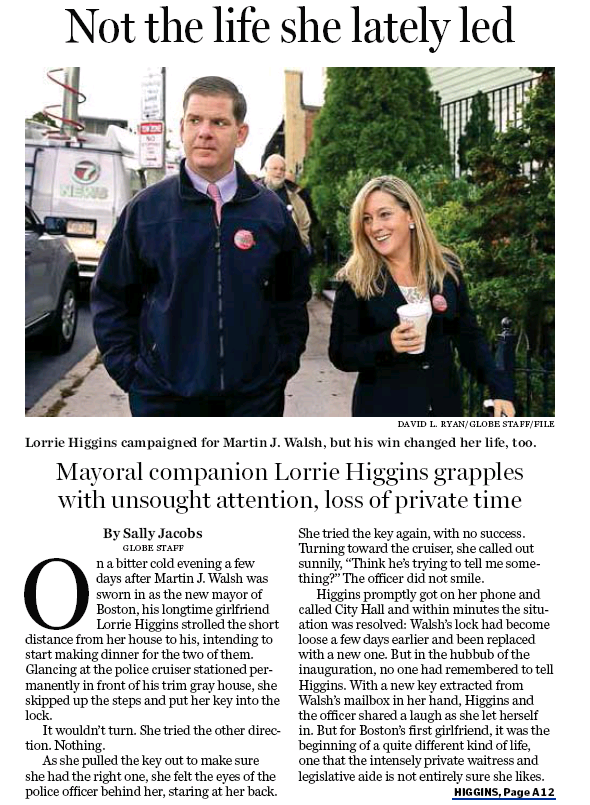
Yesterday the Boston Globe front-paged Walsh’s longtime galpal Lorrie Higgins.
It struck the hardreading staff as odd that the piece would identify Higgins as “the intensely private waitress and legislative aide,” especially because it later reports she has taken a temporary leave from waitressing. But why get technical about it.
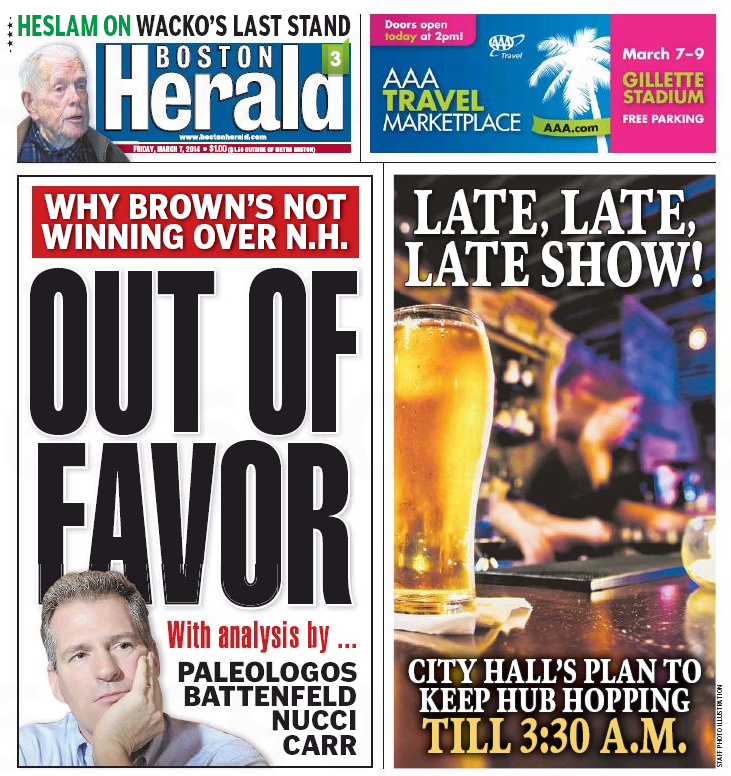
Not to be outdone, today’s Boston Herald pulls rank on the Globe.
Mom dishes on Marty Walsh
Mary Walsh — the mayor’s mom — would love to see her oldest son marry his longtime girlfriend.
“Oh, I would some day. I would love it,” she tells me when I ask her if she’d like to see her boy, Mayor Martin J. Walsh, tie the knot with his Savin Hill sweetheart, Lorrie Higgins.
“I love Lorrie and I love Lauren,” she said of Higgins and her daughter. “I love her whole family. They’re great people.”
But there’s no pressure.
“I never tell my kids what to do,” she said.
So in the end it’s all about the girlfriend. One way or another.
Today marks the latest round in the Great Boston Casino Slapfight between Wynn Resorts (wants to bring gambling – sorry, gaming – to Everett) and Mohegan Sun (wants to build a stately pleasure dome in Revere).
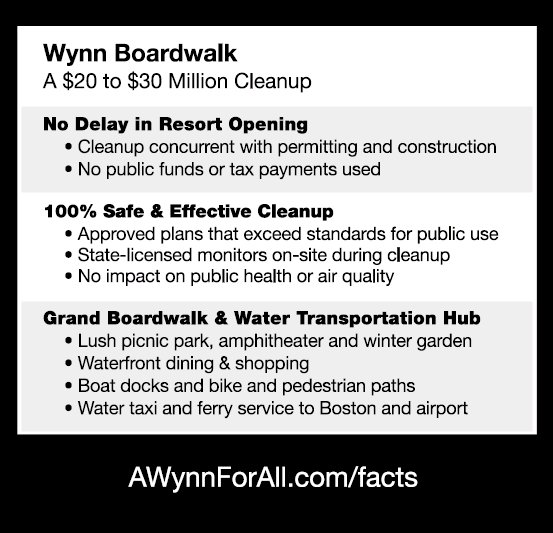
Slappy Bird #1 is running its second newspaper ad in an attempt to swing public opinion in its favor. From today’s Boston Globe’s op-ed page, in two pieces for legibility (the same ad ran in today’s Boston Herald as well):
Not everyone is buying into that sunny-side-up projection, though. Last month the Globe reported that any cleanup comes in the wake of new state environmental regulations, slated to take effect this spring, “[that] would double the amount of lead and increase by 150 percent the amount of arsenic allowed to remain in dirt 15 feet or more below the surface.”
That has the eco-set all lathered up, despite assurances from Wynn’s hired hands.
Officials representing Wynn Resorts, which has promised to spend as much as $30 million over about six months to clean the property, said the proposed regulations would have little impact on their plans.
“Any cost differential of the new regulations is marginal,” said Larry Feldman, a senior principal at GZA GeoEnvironmental, an environmental consulting firm in Norwood, who helped draft Wynn’s remediation plan and who sits on the environmental agency’s waste site cleanup advisory committee. “It’s not a big issue.”
That’s a classic content-free corporate statement, unlikely to satisfy local residents “worried that construction activity would produce dangerous dust particles of arsenic and lead that could be sent airborne and settle in the neighborhood, leach into the Mystic River, and get spread by trucks moving the dirt elsewhere.”
Maybe change that website to AWynnForSome.com, yeah?
As the hardreading staff has previously noted (here too), the Boston Globe has been pretty loosey-goosey in meeting its disclosure responsibilities about John Henry’s dual ownership of the Globe and the Boston Red Sox.
Some Fenway fans apparently have insatiable appetites — but not necessarily for baseball.
Hoping to capitalize on Red Sox Nation’s hunger for Fenway Franks, the organization plans to start selling the famous hot dogs outside the ballpark, at a Lansdowne Street concession stand. Even when a game isn’t on the menu.
Boston’s Zoning Board of Appeals on Tuesday gave unanimous approval for the stand, which will also serve other food and nonalcoholic beverages. The opening date and hours of operation have not been set, but the Red Sox plan to have it up and running this season, said spokeswoman Zineb Curran.
And etc. But nowhere does the piece acknowledge that John Henry’s newspaper is reporting on John Henry’s corporate interests.
Seriously?
Hey, Boston Globe Publisher Henry: Hasn’t anyone told you that it could be bad for business if people start viewing your paper as the Fenway Gazette & Papi?
Wellesley College economics professor Julie Matthaei is a Marxist living in a modern-day commune in Cambridge who has carved out an academic niche questioning the status quo. She is unapologetic about her beliefs, describing herself on her Wellesley Web page as a “Marxist-feminist-anti-racist-ecological-economist.”
But she was stunned recently when this description was used against her in a full-page advertisement in The New York Times by a murky pro-business group opposed to raising the minimum wage. Matthaei was among 600 academic economists who signed a petition supporting a minimum-wage increase, which the ad tried to discredit.
The Times ad:
The Globe piece noted that “[t]he Times ad, taken out by the nonprofit Employment Policies Institute in Washington, had a distinctly 1950s flavor, employing excerpts from quotes that used derivatives of ‘Marx’ four times, praised Soviet-style socialism, and questioned official accounts of the Sept. 11 attacks.”
It also noted this:
It is unclear who is funding the Employment Policies Institute; research director Michael Saltsman declined to name the businesses, foundations, and individuals who are major donors.
It might be hard to name “the businesses, foundations, and individuals who are major donors” of the Employment Policies Institute, but it’s totally clear who’s behind it: the Berman-industrial complex detailed here.
Hey, Globeniks: Get hip – Rick Berman is the King of Potemkin non-profits.
The hardreading staff knows the definition of news is changing (see virtually any David Carr column in the New York Times), but only in the Boston Herald can its own columnist’s humping his cut ‘n’ paste books be considered worthy of space in the newshole.
From today’s flacky local tabloid.
To the best of our knowledge Howie Carr is no relation to David Carr (much to the latter’s relief, we’d guess). Even so, Howie’s just bustin’ his buttons, isn’t he?
With medical marijuana set to debut in Massachusetts several months from now, there’s been a lot of coverage about the botched rollout of dispensary licenses in the Bay State. Parallel to that, there’s also a minor rumpus unfolding over TV spots for New York-based Medical Cannabis Network and its website MarijuanaDoctors.com.
The first ones who stand to make a windfall off medical marijuana aren’t necessarily the dispensaries or doctors; they might just be the advertisers and the media that air their campaigns.
In April, months before the first dispensaries are scheduled to open in Massachusetts this summer, what’s expected to be the Northeast’s first marijuana-related commercial is due to air on major networks, opening the floodgates to what could turn out to be big business for both the companies that create the commercials and the ones that run them.
“I would imagine medical marijuana sales will probably reach the hundreds of millions of dollars, and advertising is usually some percentage of gross revenue, so it could be a very big potential revenue source,” said Bruce Mittman, president of Mittcom, a local advertising agency.
New York-based Medical Cannabis Network has booked airtime through Comcast Spotlight to advertise marijuanadoctors.com, which pairs patients with doctors in their area who will evaluate whether marijuana should be used for their serious illness or chronic pain, according to founder Jason Draizin.
The first medical marijuana commercial slated to run on television in Massachusetts next month has vaporized — at least when it comes to airing through Comcast.
The ad failed to make its debut this past week in New Jersey because Comcast Spotlight, the advertising sales division of Comcast, rejected the ad as unsuitable.
“All commercials are subject to final review by Comcast Spotlight prior to airing and during that process it was determined that the spot did not meet our guidelines,” Comcast spokesman Steven Restivo said yesterday.
The offending TV spot:
According to MarijuanaDoctors.com spokeswoman Janet Falk, “MarijuanaDoctors.com has been approached directly by several TV stations and cable networks regarding advertising in Massachusetts.”
On Friday Boston Mayor Marty Walsh announced a long-overdue overhaul of the Jurassic Boston Redevelopment Authority, which Saturday’s edition of the feisty local tabloid reported with a big shootout to itself.
BRA housecleaning gets rave reviews
Mayor Martin J. Walsh’s surprise shake-up of the Boston Redevelopment Authority — a move that saw its business development arm and 14 staffers axed — was hailed by critics as the first step in a long overdue overhaul of an agency notorious for its cronyism and backroom deals.
“We are at a point with the BRA where any changes would be positive. I think things at the BRA have operated in the shadows for far too long,” said Matt Cahill, head of the Boston Finance Commission, a watchdog agency. “It appears that Mayor Walsh is trying to increase transparency and the public’s knowledge of what’s going on there.”
While the moves — first reported yesterday on boston herald.com — don’t go as far as Walsh’s campaign pledge to dismantle the BRA entirely, they are part of his overall strategy to shift economic development away from the independent authority and under the umbrella of a City Hall department that reports directly to the mayor.
Of course, considering that bostonherald.com is the Lindsay Lohan of websites, it’s impossible to verify the paper’s “first reported yesterday” claim.
But we can verify this: The Boston Globe, which is generally not shy about crediting the Herald when it scoops the stately local broadsheet, did not cite the Herald in itsSaturday piece.
Like Halley’s Comet, a correction in in the Boston Herald is something to both marvel at and celebrate.
So it is with the note that appears at the top of page 2 in today’s Herald.
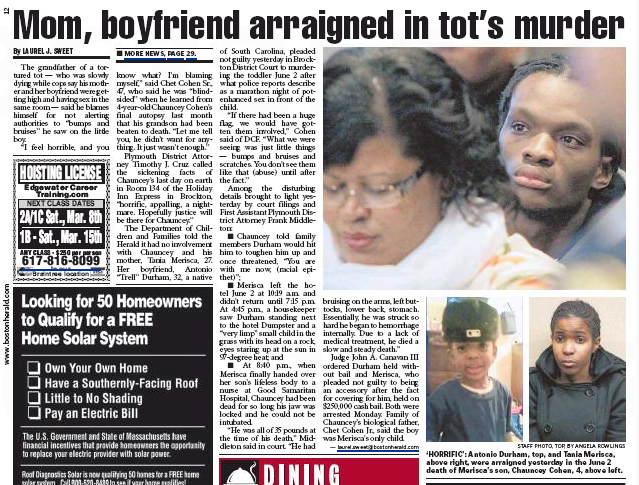
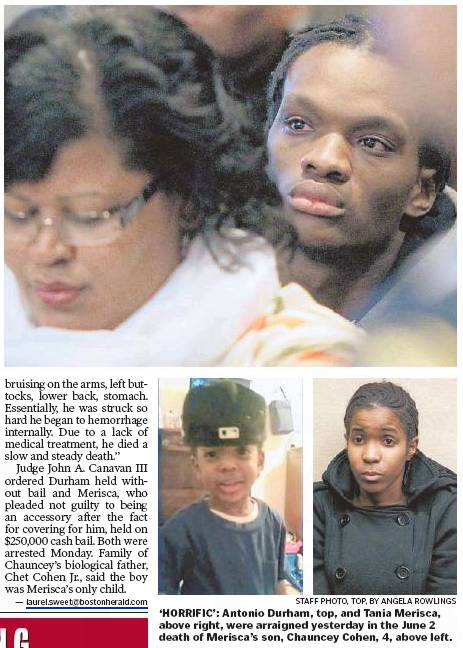
That would be this page 12 yesterday, which reported the murder of Brockton four-year-old Chauncey Cohen.
And specifically this caption, which calls the victim’s father by the alleged killer’s name.
Ouch.
The hardreading staff has nothing but sympathy for the Heraldniks here, since this kind of error is the monster under every journalist’s bed. Good for the Herald for not burying its mistake, but correcting it with the prominence it deserves.



 Posted by Campaign Outsider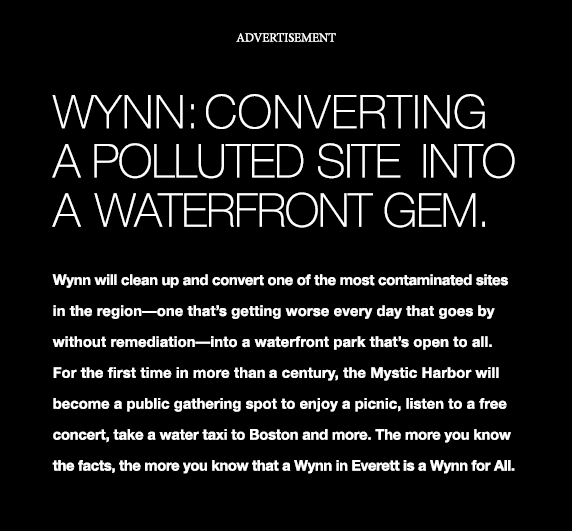




 It's Good to Live in a Two-Daily Town